

- OP Labs formerly Oxford Peptides
- Manufactured to defined specification
- Store at ambient temperature in absolute darkness
- Sold for research purposes only
- Contact us for Wholesale Orders
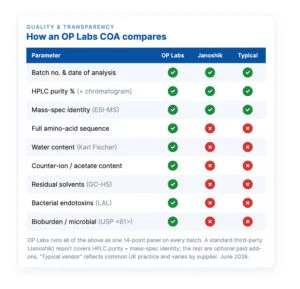
Search our database for full COA analytics here.
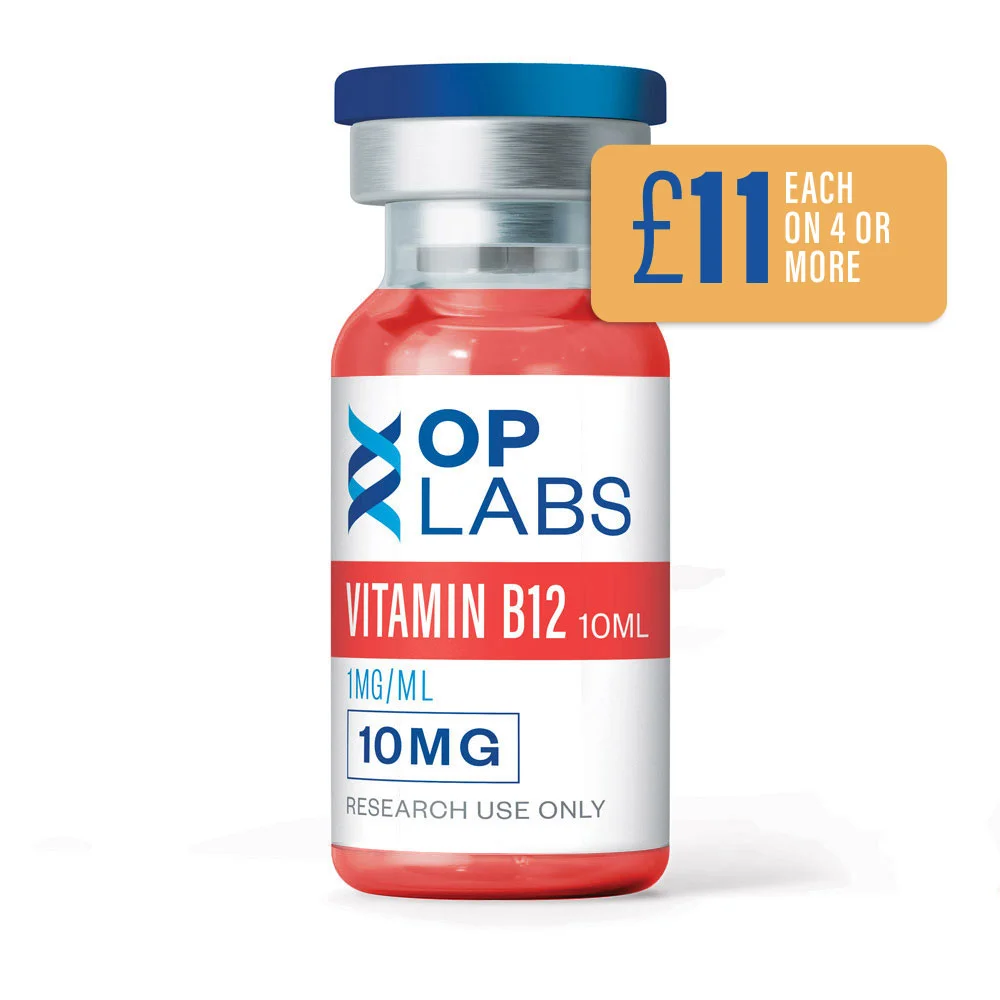
Vitamin B-12 (Cyanocobalamin) – 10 mL Solution
Synonyms / Designations: Vitamin B-12, Cobalamin, Cyanocobalamin, Hydroxocobalamin, Methylcobalamin.
CAS Number: 68-19-9 (Cyanocobalamin reference form)
Molecular Formula: C63H88CoN14O14P
Molecular Weight: ~1355.38 g/mol
Compound Classification: Naturally occurring cobalt-containing corrinoid vitamin
Specifications
- Form: Aqueous solution
- Concentration: 1000 µg/mL (nominal) Vitamin B-12
- Volume: 10 mL
- Filtration: 0.2 µm sterile membrane
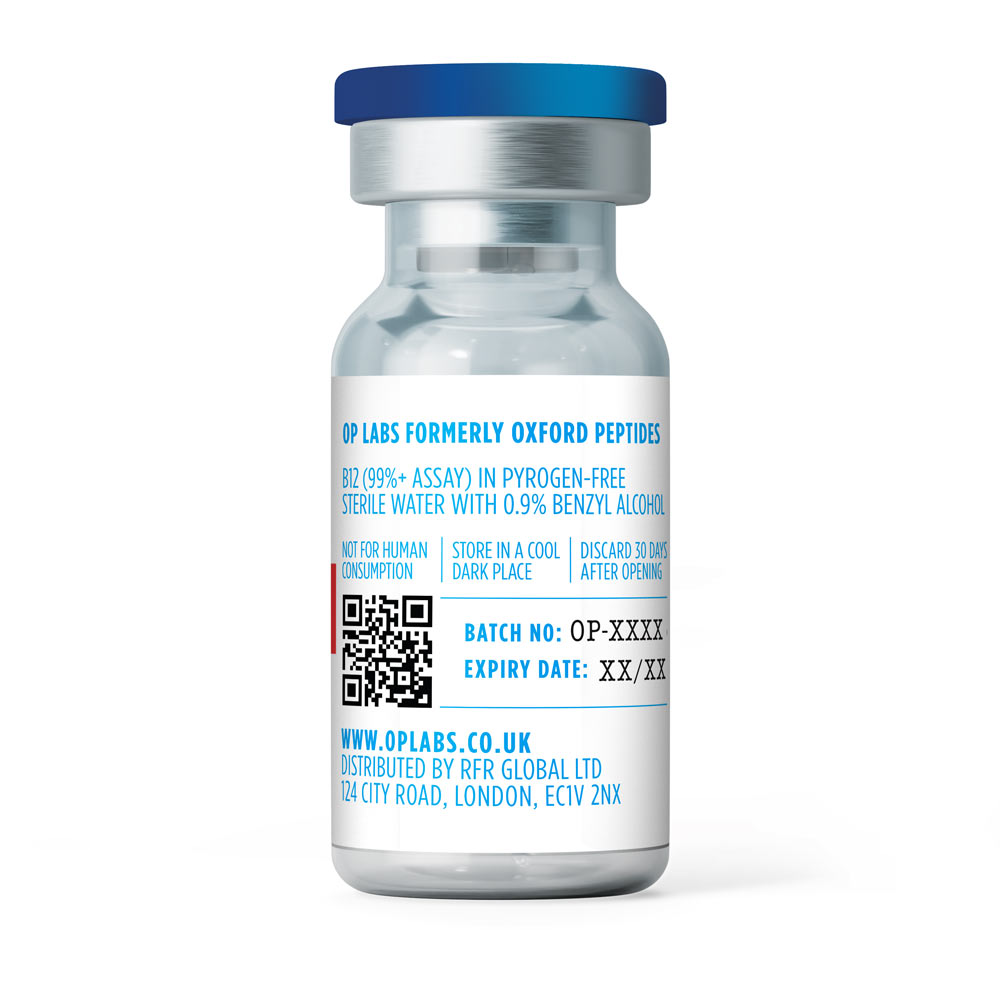
- Preservative: 0.9% Benzyl Alcohol
- Container: Sterile glass vial
- Appearance: Red solution
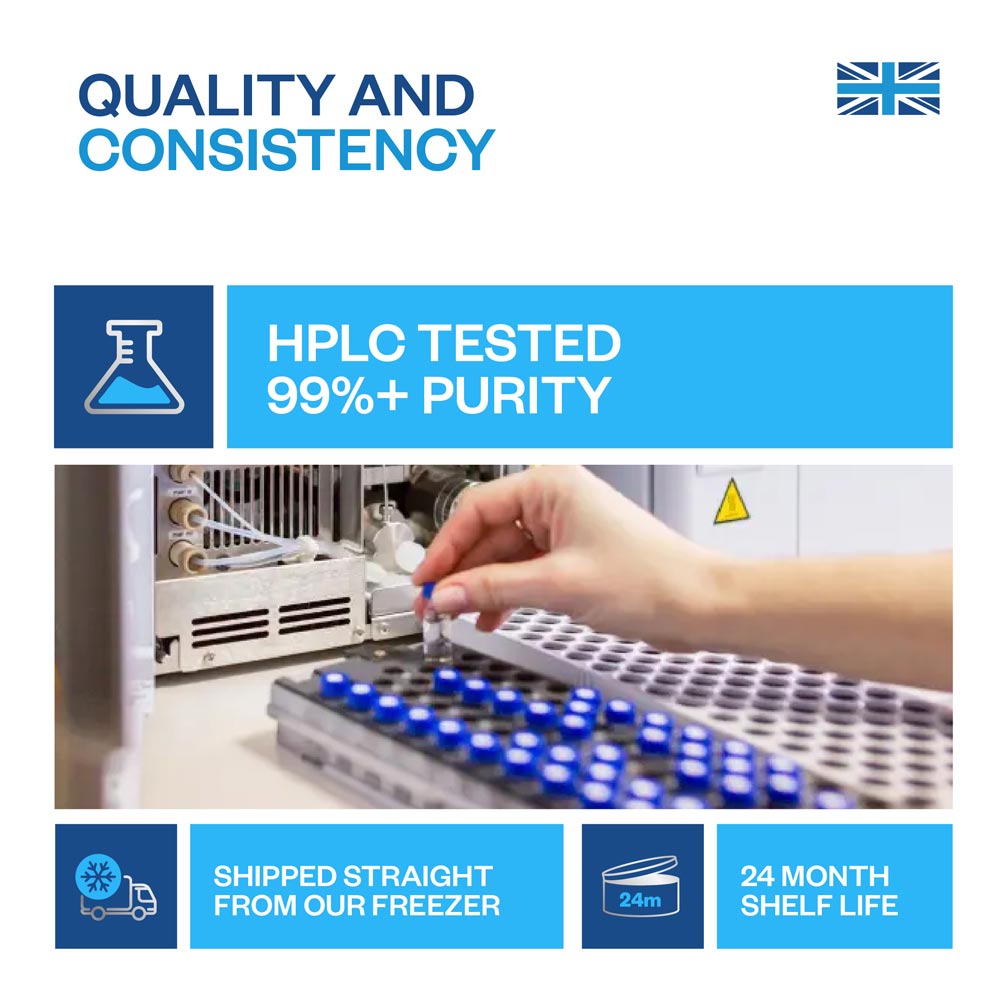
- Purity: Manufactured to defined specification (≥98% assay cyanocobalamin; HPLC / spectroscopic methods, typical)
- Solubility: Soluble in water; slightly soluble in ethanol; insoluble in non-polar solvents
Storage & Stability
- Shelf life: 1.5 years from manufacture (21 °C)
- Store at ambient temperature in absolute darkness; degrades on exposure to light/UV
- Once opened, use or discard within 30 days
- For full storage and expiry information, please refer to the batch code on the vial
Description & Mechanism
Vitamin B-12 is a water-soluble, cobalt-containing vitamin essential for fundamental biochemical processes in cellular metabolism. It functions as a cofactor for key enzymatic reactions involved in one-carbon metabolism, nucleic acid synthesis, and mitochondrial energy regulation.
In biochemical and cellular research systems, Vitamin B-12–dependent enzymes such as methionine synthase and methylmalonyl-CoA mutase are studied for their roles in DNA synthesis, amino acid metabolism, and fatty acid processing. Experimental models utilise Vitamin B-12 to investigate cofactor-dependent enzymatic activity, intracellular transport mechanisms, and nutrient–enzyme interactions under controlled conditions.
Applications in Research
- Investigation of one-carbon metabolism and methylation pathways
- Study of cofactor-dependent enzymatic reactions
- Cellular metabolism and mitochondrial function research
- Nutrient transport and vitamin uptake studies
- Reference compound in biochemical and nutritional research
Handling
- Handle using standard laboratory precautions
- No reconstitution required — supplied as a ready-to-use sterile solution
- Protect from light at all times
- Do not freeze; storage at ambient temperature in darkness is recommended
Precautions & Notes
- Stability may be affected by light, heat, and extreme pH
- Experimental outcomes depend on concentration, model system, and formulation
- Appropriate controls are recommended for enzymatic and cellular assays
- Intended strictly for laboratory research use; not for human or veterinary application
References
Banerjee R., Ragsdale S.W. The many faces of vitamin B12: catalysis by cobalamin-dependent enzymes. Annual Review of Biochemistry, 2003.
https://www.annualreviews.org/doi/10.1146/annurev.biochem.72.121801.161828
O’Leary F., Samman S. Vitamin B12 in health and disease. Nutrients, 2010.
https://www.mdpi.com/2072-6643/2/3/299
Froese D.S., Gravel R.A. Genetics of intracellular vitamin B12 metabolism. Molecular Genetics and Metabolism, 2010.
https://pubmed.ncbi.nlm.nih.gov/21114891/
Keywords: Vitamin B-12, Cobalamin, Cyanocobalamin, Methylcobalamin, One-Carbon Metabolism, Cofactor Enzymes, Cellular Metabolism