
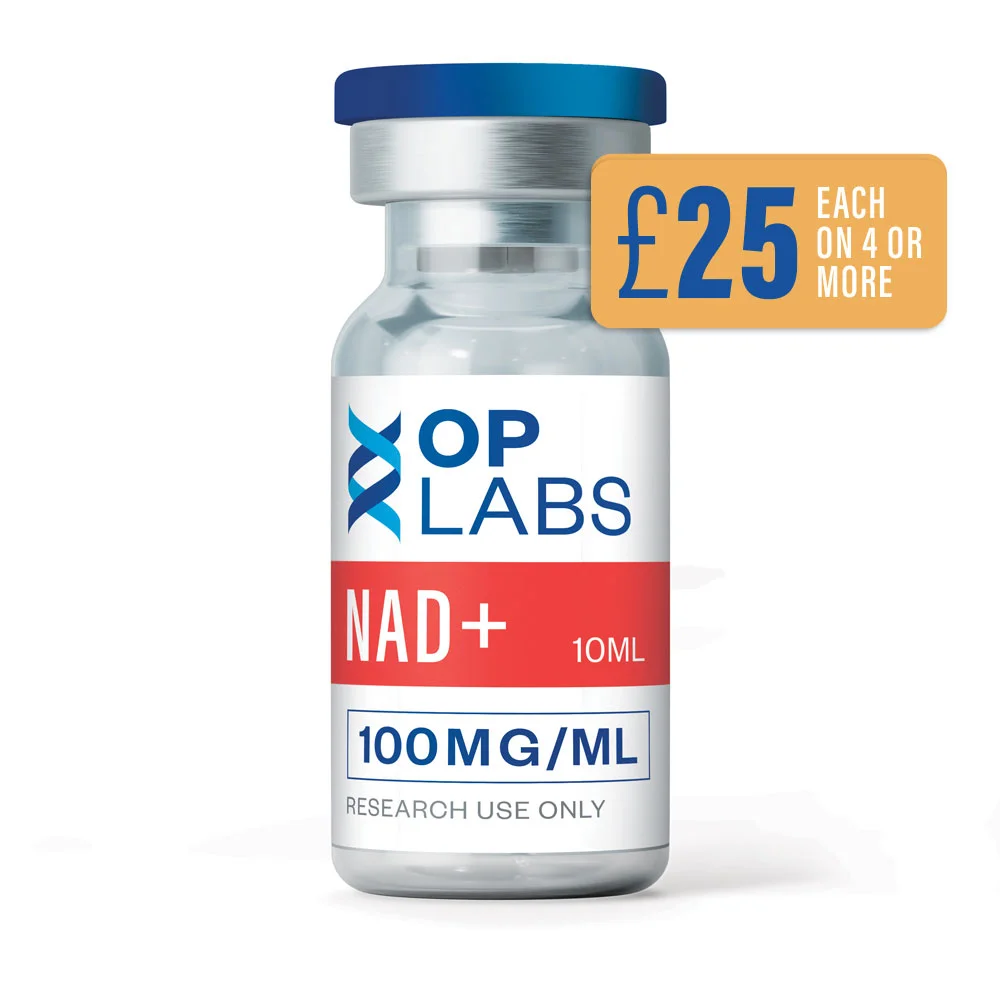
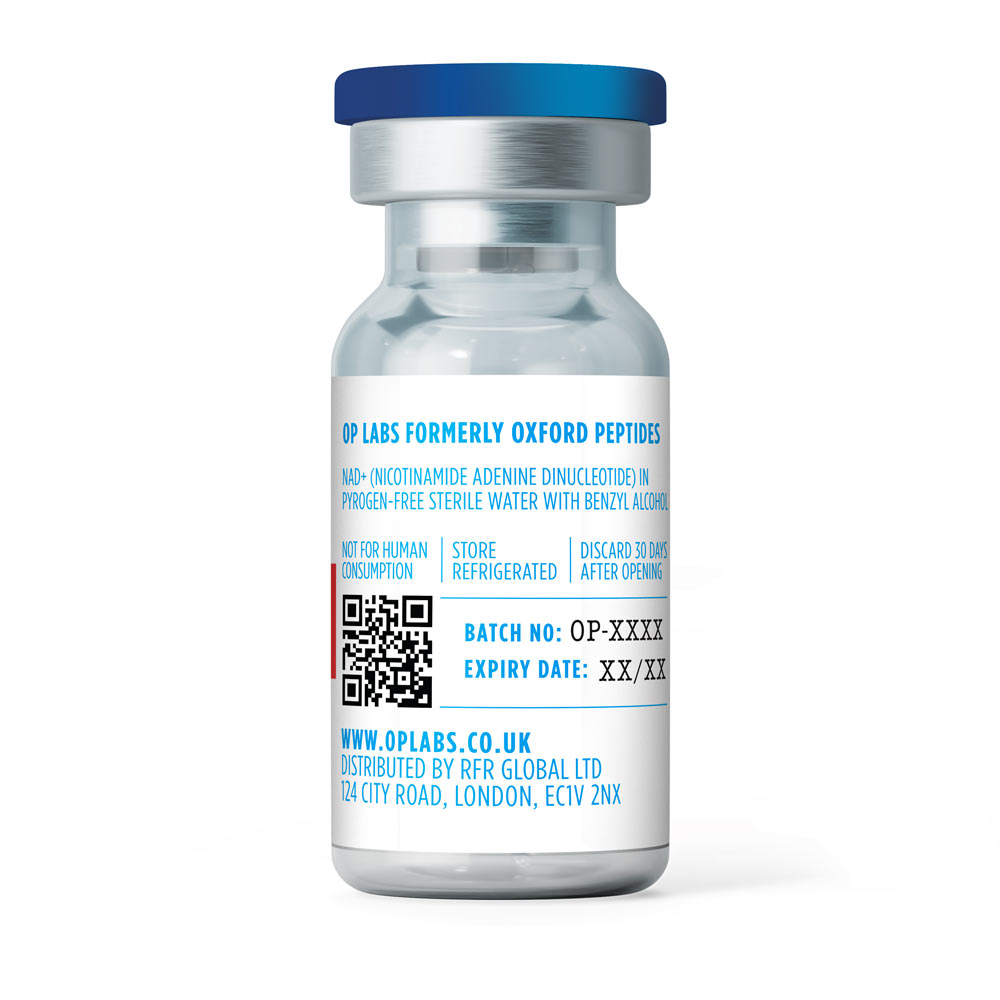
- OP Labs formerly Oxford Peptides.
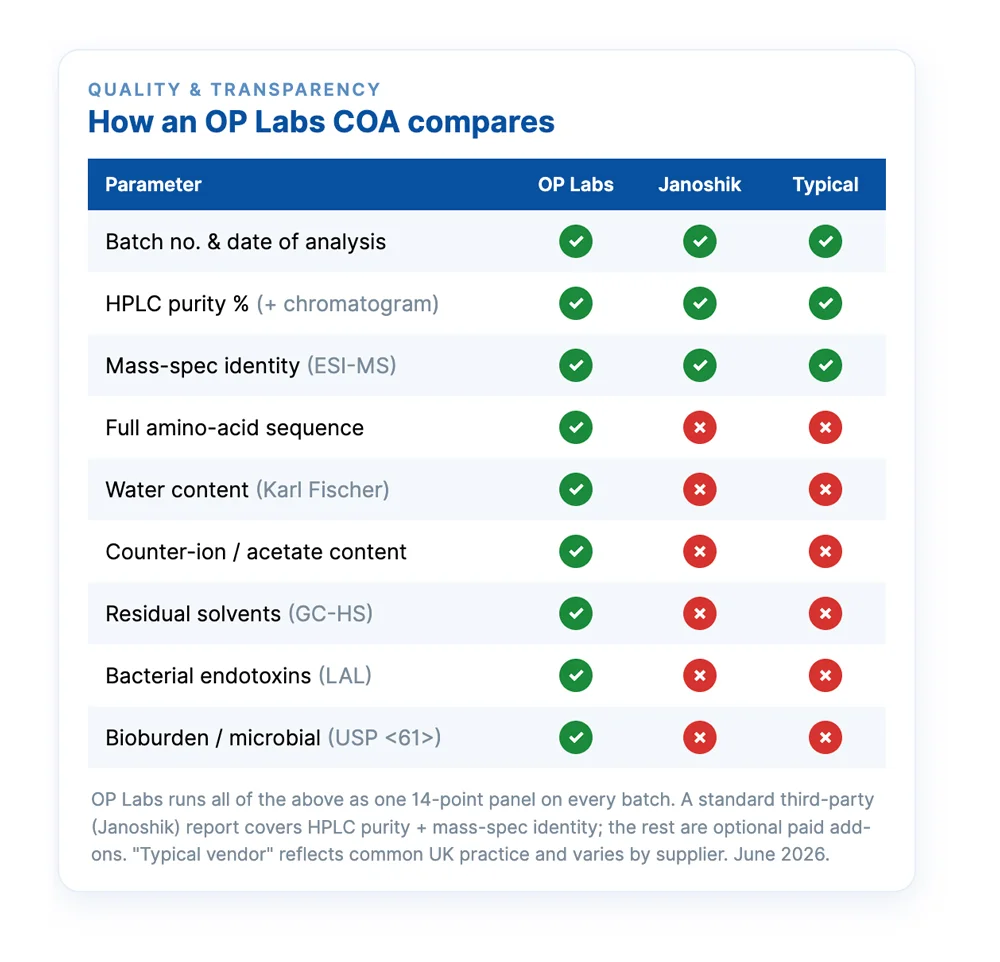
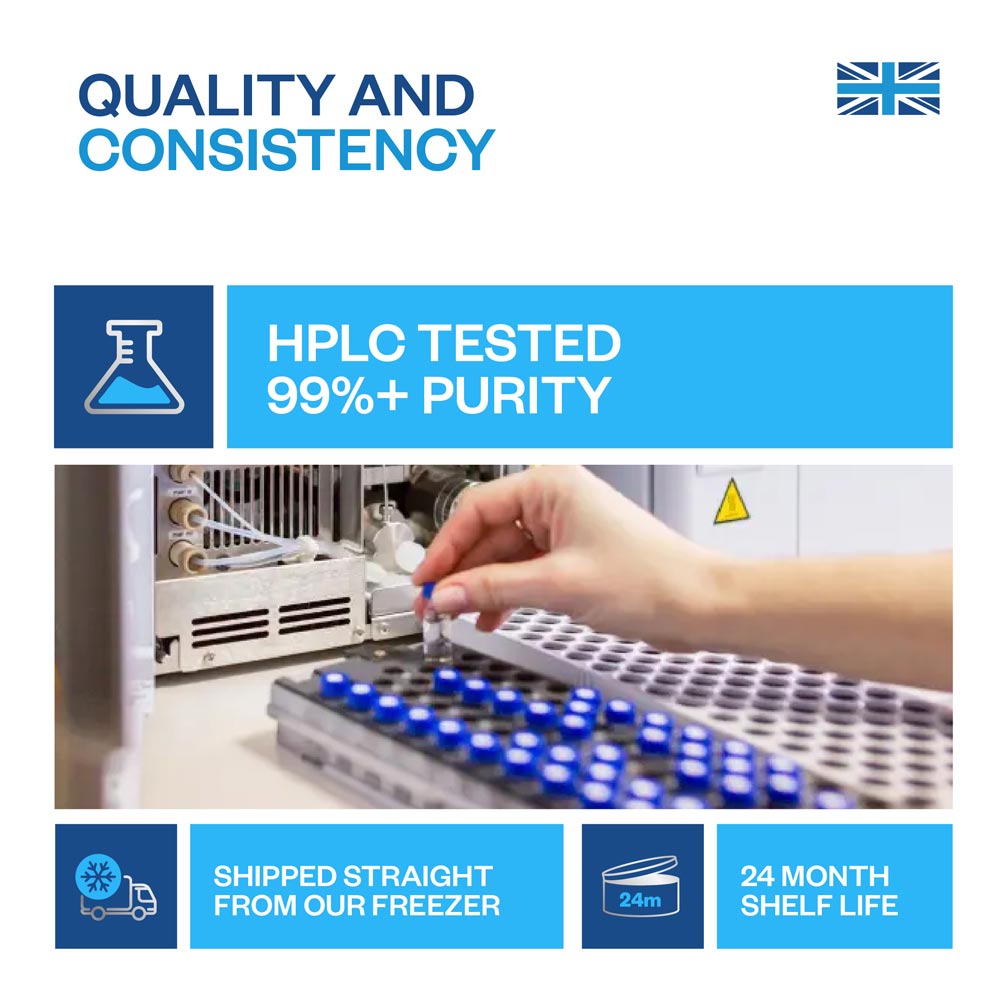
- Batch HPLC tested at 98.5%+ purity.
- Store in a cool dark place
- Sold for research purposes only.
- Contact us for Wholesale Orders.
Search our database for full COA analytics here.
NAD+
Synonyms / Designations: NAD+, Nicotinamide Adenine Dinucleotide (oxidised form), b-NAD+
CAS Number: 53-84-9
Molecular Formula: C21H27N7O14P2
Molar Mass: ~663.43 g/mol
Chemical Classification: Pyridine nucleotide coenzyme
Purity: 99 % (HPLC, typical)
Appearance: Clear liquid
Pack Size: 10ml
Storage: Store in a cool dark place. Discard 30 DAYS after opening.
Description & Mechanism
Nicotinamide adenine dinucleotide (NAD+) is an endogenous pyridine nucleotide that functions as a central redox cofactor and signalling molecule in cellular metabolism. In its oxidised form, NAD+ participates in electron transfer reactions fundamental to oxidative phosphorylation, glycolysis, and mitochondrial energy production.
In biochemical and cellular research systems, NAD+ is extensively studied for its role in redox balance, substrate availability for NAD+-dependent enzymes, and regulation of intracellular signalling pathways. These include sirtuins, poly(ADP-ribose) polymerases (PARPs), and cyclic ADP-ribose–generating enzymes involved in DNA repair, chromatin regulation, and calcium signalling. Experimental outcomes are influenced by intracellular NAD+/NADH ratios, compartmentalisation, and metabolic state of the model system.
Applications in Research
• Investigation of cellular redox metabolism and mitochondrial function
• Studies of NAD+-dependent enzymes including sirtuins and PARPs
• In vitro research on energy homeostasis and metabolic signalling pathways
• Use as a reference compound in enzymology and metabolic research
Handling & Stability
- Store in a cool dark place. Discard 30 DAYS after opening.
- Shelf life: 30 MONTHS from production
Specifications Summary
Purity: 100mg/ml
Appearance: Clear liquid
Chemical Type: Pyridine nucleotide coenzyme
Molecular Weight: ~663.43 g/mol
Storage: Store in a cool dark place. Discard 30 DAYS after opening.
Pack Size: 10ml
Precautions & Notes
- Experimental behaviour of NAD+ is influenced by pH, temperature, and redox environment.
- NAD+ is sensitive to hydrolysis under acidic or basic conditions.
- Appropriate controls are recommended when interpreting enzyme-dependent effects.
- Intended strictly for laboratory research use only; not for human or veterinary application.
References
Verdin E. NAD⁺ in aging, metabolism, and neurodegeneration. Science, 2015.
https://pubmed.ncbi.nlm.nih.gov/26785480/
Covarrubias A.J. et al. NAD⁺ metabolism and its roles in cellular processes during ageing. Nature Reviews Molecular Cell Biology, 2021.
https://www.nature.com/articles/s41580-020-00313-x
Rajman L. et al. Therapeutic potential of NAD-boosting molecules: the in vivo evidence. Cell Metabolism, 2018.
https://pubmed.ncbi.nlm.nih.gov/29514064/
Braidy N., Liu Y. NAD⁺ therapy in age-related degenerative disorders: a benefit/risk analysis. Experimental Gerontology, 2020.
https://pubmed.ncbi.nlm.nih.gov/31606488/
Keywords :NAD+, Nicotinamide Adenine Dinucleotide, Pyridine Nucleotide, Redox Cofactor, Mitochondrial Metabolism, Enzymology, Metabolic Research
Zubair A (Verified Purchase) –
Denise Wadey (Verified Purchase) –
Frenchy –
Mega
Paulo Reis Viegas (Verified Purchase) –
Excellent
MW (Verified Purchase) –
This works for me. Next day delivery as advertised. Great communication. 👍
marc swinburne (Verified Purchase) –
Ray (Verified Purchase) –
Great product. Highly recommended.
Nick (Verified Purchase) –
Great product always on time !
Kathryn (Verified Purchase) –
Excellent quality. I always feel the benefits of OPs quality of products.
Erica Holland (Verified Purchase) –
Quick delivery, great product, packaged well, have placed many orders with OP labs now and never any issues.
Dougie Stryke (Verified Purchase) –
Silvia (Verified Purchase) –
Same as Glutathione, already mix, never saw it before
Gary (Verified Purchase) –
Janis (Verified Purchase) –
Ray (Verified Purchase) –
Reliable stockist and reliable product. No issues.
Simon Dawson (Verified Purchase) –
this one is a slow burner but finding the right amount and timing , definitely worth every penny, no crash in the mid afternoon now, bought this product multiple times now.
Sam (Verified Purchase) –
Not used as yet but heard amazing things
Pedro domingues (Verified Purchase) –
CB (Verified Purchase) –
Love it, great quality and great price
Matt Hopson (Verified Purchase) –
It stings like it should be very unsettling to see nad+ in a clear glass bottle
Light degrades it fast and with it being reconstituted already it’s not the best way to sell it
But it’s so cheap compared to the whole other market in the uk
Andy Holton (Verified Purchase) –
Really good
Jon Hughes (Verified Purchase) –
Inese Melke (Verified Purchase) –
JARRED –
Outstanding product! Top quality
Stuart (Verified Purchase) –
Philip H. (Verified Purchase) –
Anonymous (Verified Purchase) –
Ahmad Saleh (Verified Purchase) –
Sinead MCGINLEY (Verified Purchase) –
It came reconstituted, did not state on site.
I only purchase lyophilized form for safety and I add my own BAC water so I know how much ml’s I am use for dosing etc.
I want to return it as I certainly won’t be using it. Customer service terrible, they stated to use their enclosed postage label. There was non in package. Last time I will use this company. Disappointed.
Ahmad Saleh –
Robert –
Richard –
Amazing
naddy chan –
This helps a lot with a lot of pains I’m in and it has also made me lose a lot of weight and I’ve had no side effects what so ever I would definitely recommend this and the BPC157+TB500
Ian S. –
Great stuff, definitely wakes you up. Quick delivery too
Lisa C. –
Been using for a few months and definitely best NAD we’ve purchased.
Bruce D. –
Adam Waldie –
Makes me feel 15 years younger. Love this.
Kenneth Dilliway –
Products are alwaysed packaged safely and delivered so fast. Always quality products.
James Keenan –
Kelly Meyrick –
Another great peptide and service
Jason Monks –
Bigger vials please
Charles N. –
A must have peptide
Stephen B. –
Fast delivery, seems to be helping with my recovery from exercise.
chen yu tsang –
Lukasz B. –
High quality products and super fast delivery
Kate R. –
Amazing energy boost, love this product. Will definitely be buying this again!
Ryan C. –
Fast delivery, works well.
Ian Shepherd –
Excellent product. First started using the online kits you can buy. At about £400 then moved to another brand at £350 still very expensive though. Then found Oxford Peptides. Did my research and discovered better quality at a fraction of the price. You have to buy your own syringes and swabs but thats no big issue. I use 25 units everyday.
Just bought my first batch of 4 @ £100 which will probably last me 6 months. Happy days.
Christopher Small –
Very good product and a good price. Delivery was so quick, arrived next day
Pawel –
Very good . Good price
Wendy Jane E. –
Excellent product
Steven S. –
Troy Wear –
Gary Tucker –
Helping with my mitochondria support!
Kathryn Edwards –
Excellent product fast delivery
Terri Smith –
Great product very happy
Ian Shepherd –
Excellent product. A***
Anonymous –
Great product and excellent value for money
Mate Janos Andrasi –
Energy bomb. If you are 40+ this is highly recommended alongside with L-carnitine for smooth extra energy
Sylvia –
Great service and fast delivery
Kathryn –
Game changer! Highly recommend!
Craig Gordon –
Been using Oxford Peptides for quite a while now and definitely have no complaints. Just got NAD+ and seems to be doing the job.
Phill –
Arrived on time , can’t say whether it’s placebo, but product was good and appears to be working both me and my freind are using
anthony reynolds –
Very fast shipping and great product!
Peter W. –
Its the real deal I wouldn’t get it from anywhere else
Krystian K. –
Anonymous –
Rory C. –
Love the quality products from Oxford. Amazing value for money with the NAD+ as well
Michael Lignum –
Great product and company
Jason Burgess –
Dylan C. –
Sebastian Schreiber –
Andrew Walker –
Karl Robinson –
Made me Ill but price reflects in quality if it’s 100 mg per ml for that price the quality can’t be as good I take nad from another company and feel fine after dose but this make me feel really sick
Anonymous –
This one is one powerful peptide.
Brett J. –
Again too early but delivery top notch.
Kat –
Fatma Latife –
PERFECT.
Anonymous –
Great product & price
Anonymous –
At first I was skeptical in ordering but to my surprise the delivery was fast and it’s really an NAD +. Now time to test the benefits of this product. Until my next order. Thank you.
Tiffany –
Lee Pratt –
Great Product. My Partner is using this.
Mark Christie –
Anonymous –
Love this stuff! Always getting comments about my skin
Zilch Z. –
Excellent product. Very quick delivery I’m impressed and highly recommended this shop.
Monika C. –
Fully professional service all process from dispatch to delivery like should looks
Sarah L. –
The quality is outstanding.
Maturaa K. –
Great product, great price.
Anonymous –
This product rocks.
Paul –
No regrets.
James –
I use it all the time.
luke williams –
Top quality.
Bev –
Just awesome.
Naomi –
Works like a charm.
Emma A. –
Great value.
Janet –
Super speedy shipping, product is excellent.
Simon Dawes –
Delivery was super fast and seamless.
Charlotte –
Delivered quickly, very satisfied.
Jack A. –
Speedy delivery, couldnÕt be happier.
Caron Butler –
Arrived fast, amazing product.
Angela S. –
Quick delivery and love the product.
Rachael Williams –
Arrived earlier than I thought.
Anonymous –
Fast delivery, super pleased.
Rebecca Wells –
Product arrived fast, love it.
Darcy –
Super quick delivery, love the product.
Kirsty H. –
Really fast delivery, highly recommend.
Clement –
Speedy delivery, great product.
Anonymous –
Fast shipping, just as described.
Lainey Poulson –
Quick delivery, product is amazing.
Bradley T. –
Delivered fast, love the product!
Sara –
Came fast, couldnÕt ask for more.
Jane Lamont –
Fast delivery, product is perfect.
Helen –
Quick delivery and love the product.
India –
Quick delivery, perfect condition.
Anonymous –
Fast delivery, great value.
Dimple B. –
So happy with the fast delivery!
Stacey Johns –
Impressed by the fast delivery!
Sophie –
Arrived way earlier than I thought.
Lois –
Got it fast, love it.
Carla B. –
Super fast delivery!
Joshua –
Great product, highly recommend.
Samantha B. –
Excellent quality product.
Rebecca –
IÕm loving this product.
Annie –
IÕm totally impressed.
Purdy Basra –
This is my go-to.
Lesley R. –
Happy with this purchase.
Rachel –
Fast shipping, just as described.
Ciara –
Truly amazing.
Anonymous –
Beyond impressed.
Abbie Laughton-Coles –
Brilliant product.
Lou H. –
Fast delivery, very satisfied with my purchase.
Anonymous –
Delivery was quicker than anticipated.
Nicole M. –
Got here fast, product is awesome.
Anonymous –
Fast delivery, super pleased.
Anonymous –
Outstanding quality.
Gemma Van –
CanÕt recommend enough.
Amelia Christian –
Brilliant product.
Owen Calaby –
Excellent value for money.
Hannah Horan –
Love the features.
Joanna Butler –
Truly excellent.
Declan Peers –
A great product.
Saara Hanso –
Arrived way earlier than I thought.
April N. –
CouldnÕt be more satisfied.
Elizabeth –
Brilliant value.
Lucy –
Works perfectly every time.
Anonymous –
Worth every penny..
Wayne Cross –
IÕm impressed.
Morgan –
I highly recommend this.
Anonymous –
A must-have.
Beth Jackson –
Incredibly fast shipping, thank you!
Claire C. –
Fast delivery, couldnÕt be happier.
Rachael Anderson –
Delivery was super quick.
James Moore –
The best product IÕve ever used.
Kim –
It stopped working already.
Jocelyn –
Expected more for the price.
Karen –
Delivery was much slower than expected.
Anonymous –
Took way too long to arrive.
Nick Morris –
It felt like forever waiting for this.
Mark T. –
Ridiculously slow delivery.
Elise –
Seriously, what took so long?
Morgan rees –
DoesnÕt live up to the hype.
Klaudia –
Really dissatisfied with this.
Laura Ramsey –
Looks nothing like the pictures.
Jack Richards –
I regret buying this.
ALISTAIR –
Expected more for the price.
Charlotte –
Had to wait ages for this.
Dennis B. –
Was expecting faster delivery, very disappointed.
Hazel –
DidnÕt work the way it should have.
Steph Ranson –
Waiting this long for a delivery is ridiculous.
Nicole –
I could have walked here faster.
Donna H. –
Why did it take so long to ship?
Margot C. –
WouldnÕt recommend because of the delivery time.
Francesca Lever –
It took forever to get here.
Gary S. –
Absolutely brilliant product great customer service the delivery was next day iv had nad+ infusions in the past and the nad+ I got from Oxford peptides are just as good if not better I had blood work done today and it’s Lowered my cholesterol and iv only been taking a couple of weeks I bought it for Longevity reasons not to look younger and I feel spot on can’t recommend these guys enough price product postage and the whole experience with this peptide lab is spot on well done be back soon !
Mark Christie –
Rachel Turner wilkinson –
Fantastic product
John O’Mahony –
Very straightforward to deal with. I made a typo in my purchase, and they were patient with me in sorting it out. They did exactly as they promised. I dont tet know how the product quality is,but I expect, based on my dealings so far, that it will be good.
Anonymous –
Love this stuff! Always getting comments about my skin
Zilch Z. –
Excellent product. Very quick delivery I’m impressed and highly recommended this shop.
Monika C. –
Fully professional service all process from dispatch to delivery like should looks
Karen W. –
Very useful and practical.
Warren R. –
One of my favorites.
Miss S Hay –
Very durable.
Pauline M. –
This is a game-changer.
CHRISTOPHER HORN –
Amazing product.
Rachel Turner –
Arrived fast, no complaints at all.
Steven Meacham –
Amazed by the quick delivery.
Beth P. –
Brilliant value.
Marion Unwin –
Super happy with how it works.
Tracy –
Best quality ever.
Christine Mcgregor –
This is my go-to.
Bethany H. –
It works so well.
Mollie –
Works better than expected.
Stephen –
Amazing quality.
Jessica –
Exceeded expectations.
Ami –
ItÕs everything I wanted.
Lydia Anthony –
Awesome purchase.
Ellen M. –
A great buy.
Verified Buyer –
This product rocks.
Sophie Palmer –
Very useful and practical.
Rebecca E. –
CanÕt recommend enough.
DANIELLE Kate –
CanÕt live without it.
Lubna Bennett –
Perfect purchase.
Sarah –
Love the ease of use.
David –
Brilliant value.
Wiktoria Pipczynska –
Incredibly useful.
karen –
Great craftsmanship.
Lewis Bensted –
IÕm very impressed.
Byron De Winter –
ItÕs a winner.
Kerry H. –
Excellent buy.
Sara M. –
Totally worth it.
Ashley Berrisford –
Amazing product.
Anonymous –
Product came fast, love the quality.
Clare M. –
Got it fast, very pleased with the quality.
Liz Ferguson –
Super fast delivery, no issues at all.
Anamaria V. –
Fast shipping, just as described.
Carly –
Came fast, couldnÕt ask for more.
Ashley Taylor –
Lightning fast shipping, highly recommend.
Aimee R. –
Fast delivery, just what I needed.
Megan –
Super speedy delivery, highly recommend.
Caroline –
Delivery was fast and hassle-free.
Natalia –
Quick shipping, great service.
Anonymous –
Product arrived fast, love it.
Gabriella –
CanÕt live without it now.
Lucy G. –
The quality is outstanding.
Laura –
A great product.
Anonymous –
Beyond satisfied.
Emma A. –
Super happy with my purchase.
Grace W. –
Totally worth the price.
Lily A. –
ItÕs perfect for me.
Jade Blundell –
Well made.
Wendy C. –
This is amazing.
Abi –
Very functional.
Rebecca Hill –
Delivers as promised.
Tracy B. –
Very practical.
Natalie Green-Wood –
Does exactly what it says.
Nicola Paling –
So glad I bought this.
Chris Edwin –
Totally worth it.
Claire –
Perfect purchase.
Katrina Macdonald –
Super convenient.
Joshua Yardley –
Love it.
Chris deignan –
Excellent performance.
Anonymous –
Very impressed with this.
Jamie –
CouldnÕt be better.
Debbie Edwards –
Beyond my expectations.
Eleanor Kelly –
Great purchase.
Sara Lincoln –
Very effective.
Katrina D. –
Great performance.
John Spicer –
Super happy with this.
Gemma –
Exactly what I needed.
stephanie –
Exceeded my expectations.
Callum F. –
Totally satisfied with this.
Helen –
Super happy with my decision.
Arthur Caulfield –
Excellent quality product.
Emma Gerrard –
CouldnÕt be more satisfied.
Georgie –
Super functional.
Natasha –
Excellent craftsmanship.
Anonymous –
ItÕs really top-notch.
Gillian –
ItÕs a perfect fit.
Jackie –
It works beautifully.
Houda Jaouhar –
A fantastic investment.
Charlotte –
Outstanding quality.
Chloe –
Truly amazing.
Sam –
High-quality product.
Venetia –
CanÕt recommend enough.
Paula Kenrick –
Best thing IÕve bought.
Anonymous –
IÕm loving it.
William –
Lives up to the hype.
Dan Hester –
Great craftsmanship.
Gemma –
Well worth it.
Callum –
Does what itÕs supposed to.
Atty –
Super efficient.
Anonymous –
Loving it so far.
Andrew –
Delivered much faster than expected.
Alice B. –
Very fast delivery, love the product.
Anonymous –
Fast delivery, great value.
Scott –
Fast delivery and excellent product.
Rhianne Litherland –
Got it delivered in record time.
Raakhi Kadambi –
Product arrived fast, love it.
Steven A. –
Product arrived in no time.
Lauren –
Arrived quicker than expected.
Mark Jackson –
Very happy with the performance.
Greig –
IÕm blown away by the quality.
Georgina –
Very dependable product.
Anonymous –
Excellent craftsmanship.
Stacey W. –
Works better than expected.
Serena Itani –
Excellent choice.
Anonymous –
Super happy with the performance.
Anonymous –
Great product, great price.
Laura –
A great buy.
Philip Worrall –
CouldnÕt be more pleased.
Anonymous –
Totally worth the price.
Daniel –
Wonderful product.
Leo McIntosh –
Very impressed with this.
Angie H. –
Excellent value for money.
Alice –
CouldnÕt ask for more.
Jessica Wootten –
Very pleased with this.
Alys B. –
Best decision ever.
Sophie Clohessy –
So glad I bought this.
Sarah Lowing –
Super happy with this.
Amy D. –
Just what I was looking for.
Leia –
CanÕt live without it.
Karen Green –
Very satisfied.
Manjit Bassi –
Love it.
Barbara C. –
Very happy with the performance.
Sophie –
IÕm blown away by the quality.
Jake Bingham –
CouldnÕt ask for more.
Eve R. –
Best quality IÕve had.
Carole –
So pleased with this.
Lee Pitt –
Amazing product will definitely will always us this company again
Simon C. –
NAD plus game changer
Dominic Harris –
Fares Alseayed –
I ordered two, but received one
Anonymous –
Very good Package the fast delivery was also nice
Peter –
Good product, good service
Paul D. –
Excellent quality
Frances Mcgilp –
It work , and not through the roof prices
Daniel Kerslake –
Felt a massive difference in the first few days with this – probably the best product I have bought in years! Highly recommend
Simon Pygall –
Excellent
Craig Spencer –
Fast postage well packaged
Anonymous –
Wow
Stephen B. –
Starting to feel like this stuff really works, only been on it a week and a half. Energy/recovery definitely increased. Only wish advice on dosage was provided. Started at 1ml per day but have reduced to 0.5ml.
Carl –
Impressed. Really speedy delivery, this product gives you an energy rush almost immediately. It’s also great value for money. I’ll be back for more!
Georgeta Vornicu –
Very satisfied
Nicoletta C. –
Very good! Fast shipping. Hope they expand product range. Waiting to hear back about a peptide
Paul Lonergan –
Product good and as described
Steven Saxton –
Absolutely spot on.. ordered my product..
Asked for next day delivery..
Delivered the next day.. service is spot on..
Steven –
Superb value for money!
Steven –
Superb value for money!
Anonymous –
Very good quality and very good delivery
Anonymous –
Peter Valentin Toader –
I’m ” testing it on my rat ” and he is enjoying it no side effects on 0.5 mll a day
Gary T. –
Excellent
Brian B. –
Best of the best , fast delivery to üíØüëç I will be buying from here again
Samantha Potts –
Good
Anonymous –
Started not full tried this for long enough but delivery was so fast and packaged well
Ruth R. –
Great product! Fast service! Very happy! Thank you
Kamal Alghalayini –
I did not recive anything till now and i have a new order Order #14397
Denise –
Great
Rory C. –
Felt effects after 45 mins. Good product
Kevin C. –
Iwona a michalska –
Great product, feel the difference already after few injections
Paul Harrison –
Great product, super fast delivery, great prices
Nathan –
Not the greatest of products couldn’t use the vial the metal pierced through the vial when opening the top cap . 🙁
Nathan –
Not the greatest of products couldn’t use the vial the metal pierced through the vial when opening the top cap . 🙁
James C. –
Lynda D. –
Suzie Irving –
Worth every penny.
Peter Norris –
IÕm loving this product.
Karen Curr –
Super happy with how it works.
Katie C. –
This product is the best.
Simon Underwood –
Incredibly useful.
Michelle Hiscutt –
Impressed by the fast delivery!
Karen Hall –
Delivery was super fast and smooth.
Anonymous –
Arrived fast, no complaints at all.
Anonymous –
Fast delivery, exceeded my expectations.
Michelle S. –
Fast shipping, really impressed.
Emma Mendes da Costa –
Delivery was fast and the product is great.
Anna C. –
Arrived so fast, couldnÕt believe it.
Roisin Lloyd –
The best product IÕve ever used.
Jane Leach –
I expected much faster delivery than this.
Tracy D. –
ItÕs everything I wanted.
Sarah –
Love this item.
Emma –
Works perfectly every time.
Verified Buyer –
Love the results.
Thomas B. –
ItÕs awesome.
David –
Extremely satisfied.
tess w. –
Love how it works.
Laura R. –
Wasn’t impressed with the slow delivery.
Paula C. –
Works incredibly well.
Louise W. –
Wonderful product.
Mandi M. –
Extremely satisfied.
Saffron W. –
Super helpful.
Jacqueline –
Worth the investment.
Felicity –
Happy customer.
alison naas –
Just awesome.
Caroline –
Came faster than expected, very happy.
Susan C. –
Fast shipping and amazing quality.
Anonymous –
Product arrived fast, love it.
Natalie C. –
Fantastic performance.
Rachel Smith –
This is top-tier quality.
Kirstey –
Not worth the wait.
Fiona Kester –
ItÕs a perfect fit.
Barbara G. –
I use it all the time.
Esme P. –
Simply amazing.
James –
Great product. Prompt delivery.üëç
Anonymous –
Overhyped and underdelivers.
Sallyann W. –
Fantastic performance.
Fiona Stone –
Not as good as I expected.
Nicola M. –
Extremely happy with this.
SAKSHI A. –
Best quality ever.
Anonymous –
This is my go-to.
Fanni F. –
Unbelievably slow delivery.
Alice Thorne –
Looks nothing like the pictures.
Fatma Erol –
I love it. I will be buying it regularly.
MORAG R. –
Quick delivery, product is amazing.
kai –
Delivered fast, love the product!
Charlette C. –
Delivery was super fast and seamless.
Jenna Kaye –
Quick shipping and excellent service.
Lucy M. –
WouldnÕt recommend because of the delivery time.
Jo-Ann –
Got here fast, product is awesome.
Amy Prescott –
Quick delivery, great quality.
Lorna –
Excellent product and fast delivery.
Dulcie R. –
So happy with the fast delivery!
Charlotte –
Impressed by the fast delivery!
Anonymous –
Why did it take so long to ship?
Jacquie –
Amazed by the quick delivery.
Matthew –
Product arrived in no time.
Scott Cooksley –
Fast delivery, very satisfied with my purchase.
Clare M. –
Quick delivery, product is amazing.
Trishna Tripuraneni –
Quick delivery, great value for money.
Heidi Banks –
Arrived quickly, love the quality.
Megan –
No complaints at all.
Anna –
Loving it so far.
Troy Miles –
Quality is amazing.
Anonymous –
Perfect for my needs.
Robyn –
Very reliable.
Amanda –
Best purchase ever.
Lewis Evans –
Does the job perfectly.
Rachel E. –
Not worth waiting this long for the product.
Manjit –
Exactly what I needed.
George Varnes –
Exceeded my expectations.
Nick Green –
Super happy with my decision.
Bethany Cowan –
Very happy with the quality.
Mark Andrews –
This is an incredible buy.
Louise Williams –
Love the ease of use.
Sarah D. –
Love the features.
Phoenix –
Works better than expected.
Jasmine Stacey –
IÕm completely sold.
Monique –
ItÕs a perfect fit.
Anonymous –
Very high-end.
Louise B. –
Simply amazing.
Anonymous –
This is amazing quality.
Nicol MacKinnon –
IÕm beyond thrilled.
Holly –
Truly excellent.
Rachael Carragher –
A great product.
Helen G. –
A great buy.
Anonymous –
Fast delivery.
Heidi Banks –
Totally worth the price.
Matthew M. –
Just amazing.
Ayrton –
Extremely satisfied.
Anonymous –
Top quality.
Chloe –
Works flawlessly.
Dave Ashdown –
So glad I bought it.
Autumn Mogford-Abbott –
So convenient.
ruby –
Does what itÕs supposed to.
Rebecca –
Works wonderfully.
Sam Morris –
Brilliant product.
Alexander P. –
Loving it so far.
Lesley Melrose –
Best decision ever.
chris watts –
Great performance.
Ray M. –
Ray M. –
Ann A. –
Great quality product.
Suzanne Cruwys –
Totally recommend it.
Anonymous –
Loving it so far.
Judith M. –
Amazing product.
Catherine Ford –
Just love how it works.
Megan Guinan –
ItÕs exactly what I needed.
Michelle Dunstan –
Totally dependable.
Martin Holding –
Excellent performance.
Neil Marshall –
Well made.
Jude –
Product arrived fast, love it.
Neil Marshall –
IÕm very impressed.
Sarah B. –
Just perfect.
Maxine –
So convenient.
Samantha M. –
Highly satisfied.
Dougy Oleary –
Works wonderfully.
Stuart Picton –
IÕm obsessed.
Molly L. –
Totally satisfied.
Gill Prentis –
CanÕt recommend this enough.
Rhanna –
Top-notch quality.
Tory G. –
Very reliable.
Susan –
Awesome quality.