
A molecule only a few amino acids long, reaching toward neurons, muscle, skin and mitochondria at once — and a field still working out which of those reaches actually lands.
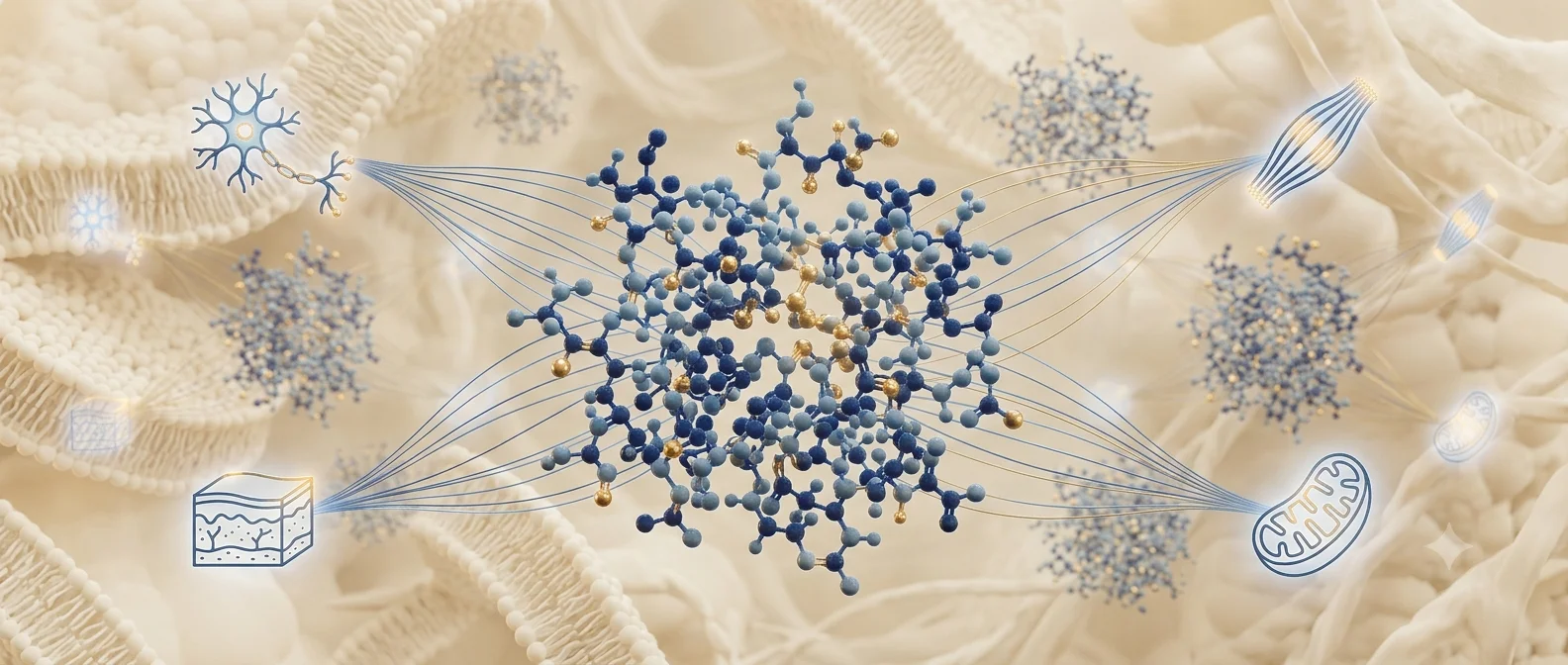
Picture a handful of small molecules suspended in a lab, each one sending out fine threads of influence — toward a neuron here, a muscle fibre there, a patch of skin, a mitochondrion quietly producing energy. That image is not far from what peptide research actually looks like up close: one class of molecule, barely a few amino acids long, reaching toward an unusually wide range of biological systems at once.
The honest answer to why is that peptide science has not settled on one big question. It is chasing several smaller ones, each at a different stage of evidence. Some have decades of human data behind them. Others are still confined to cultured cells in a dish. Knowing which is which matters more than knowing the names of the molecules themselves.
Can a peptide actually reach where it needs to go?
Before any question about effect can be answered, researchers have to answer a more basic one: does the peptide survive long enough to act? Peptides are fragile. Enzymes in the blood and gut break them down quickly, often within minutes (Fosgerau & Hoffmann, 2015). This is why so much early-stage research is not about what a peptide does, but about whether it gets the chance to do anything at all.
Delivery and stability are now their own subfield. Researchers test modified backbones, alternative administration routes, and encapsulation methods, all aimed at the same problem: keeping the molecule intact until it reaches its target (Muttenthaler et al., 2021). A peptide that looks promising in a test tube is often unusable in a living system simply because it never arrives.
What is the molecule actually doing at the cellular level?
Once a peptide is confirmed to be stable and pure — typically verified by HPLC and tandem mass spectrometry (MS/MS) for sequence confirmation — the next question is mechanistic. In vitro studies, where peptides are applied to cells grown in a laboratory dish, are usually the first port of call (Hartmann & Meisel, 2007).
These studies ask narrow, specific questions. Does the peptide bind to a particular receptor? Does it switch a gene on or off? Does it change how a cell behaves under stress? In vitro work is fast, cheap, and controllable, which makes it the right tool for early mechanism-hunting. But cells in a dish are not a body. Cultured cells are stripped of immune systems, hormonal feedback, and the structural environment they would normally sit inside (Pampaloni et al., 2007). A result here is the beginning of a question, not the answer to one.
Does the effect hold up in a living organism?
The next question researchers ask is whether an effect seen in vitro survives contact with an actual biological system. Animal models — typically mice or rats — are used to test this, because they allow researchers to observe a peptide’s effects across whole, interconnected systems: circulation, immune response, organ function, ageing pathways (Mak et al., 2014).
This stage filters out a lot of promising-looking in vitro results. A peptide that altered gene expression cleanly in a dish may be metabolised too fast to have any measurable effect in a mouse, or may produce effects in tissues nobody was testing for. Animal studies are still not human studies, but they are the bridge most peptides have to cross before anyone seriously considers testing them in people.
What happens when the peptide is tested in humans?
This is where the evidence becomes most directly relevant — and also where it is thinnest. Randomised controlled trials, where one group receives the peptide and another receives a placebo, remain the gold standard for testing whether an effect is real rather than coincidental (Friedman et al., 2015). This design accounts for the placebo effect and for ordinary day-to-day variation in how people feel.
For most peptides discussed in longevity and research circles, human trials are limited — small sample sizes, short durations, or simply not yet conducted at scale. This is not a reason to dismiss the underlying science. It is a reason to be precise about what stage that science is actually at.
Why do some headline results fail to replicate?
A question that runs underneath all peptide research, and biomedical research generally, is reliability. Early, exciting findings frequently shrink or disappear when larger or better-designed studies are run (Ioannidis, 2005). This is not unique to peptides — it is a structural feature of how science self-corrects over time.
There is also a documented pattern where industry-funded studies report more favourable outcomes than independently funded ones, likely reflecting both publication bias and study design choices (Lundh et al., 2017). None of this means individual findings are wrong. It means a single positive study, however well covered online, is a data point — not a conclusion.
So what is the field actually converging on?
Put together, the questions modern peptide research is asking form a kind of funnel: can it survive in the body, what does it do to cells, does that hold up in animals, does it hold up in people, and does the result replicate. Most compounds discussed publicly are somewhere in the middle of that funnel — past the cell-culture stage, into animal models, with human evidence still emerging. The evidence remains preliminary for the majority of claims circulating in popular science coverage.
That image of a single molecule reaching toward neurons, muscle fibres, skin, and mitochondria is the right one to hold onto — but reaching toward a system is not the same as having a confirmed effect on it. Understanding where a specific peptide sits in that funnel is more useful than memorising what it is supposed to do. It is also the only honest way to read the research that follows.
If you want to see how this plays out for a specific molecule, our next piece examines GHK-Cu and the evidence behind claims about its role in tissue remodelling — including which claims are supported by human data, and which remain confined to laboratory and animal models.
Further reading from our research series
- What Is a Peptide? The tiny molecule your body already speaks — start here.
- From Cone Snail Venom to the Lab Bench Where peptides really come from — nature’s chemistry kit.
- Peptides vs Proteins vs Amino Acids Letters, words, sentences — the real differences.
- From Insulin to Now: A Century of Peptide Discovery How a sleepless surgeon’s idea started modern peptide science.
- NAD+: The Molecule Behind Cellular Energy The coenzyme at the heart of how cells make energy — and age.
- GHK-Cu: The Copper Tripeptide in Your Bloodstream A 50-year-old molecule, examined with measured eyes.
References
- Fosgerau, K. & Hoffmann, T. (2015). Peptide therapeutics: current status and future directions. Drug Discovery Today, 20(1), 122–128. https://doi.org/10.1016/j.drudis.2014.10.003
- Friedman, L. M., Furberg, C. D., DeMets, D. L., Reboussin, D. M. & Granger, C. B. (2015). Fundamentals of Clinical Trials (5th ed.). Springer. https://doi.org/10.1007/978-3-319-18539-2
- Hartmann, R. & Meisel, H. (2007). Food-derived peptides with biological activity: from research to food applications. Current Opinion in Biotechnology, 18(2), 163–169. https://doi.org/10.1016/j.copbio.2007.01.013
- Ioannidis, J. P. A. (2005). Why most published research findings are false. PLOS Medicine, 2(8), e124. https://doi.org/10.1371/journal.pmed.0020124
- Lundh, A., Lexchin, J., Mintzes, B., Schroll, J. B. & Bero, L. (2017). Industry sponsorship and research outcome. Cochrane Database of Systematic Reviews, 2, MR000033. https://doi.org/10.1002/14651858.MR000033.pub3
- Mak, I. W., Evaniew, N. & Ghert, M. (2014). Lost in translation: animal models and clinical trials in cancer treatment. American Journal of Translational Research, 6(2), 114–118. https://www.ncbi.nlm.nih.gov/pmc/articles/PMC3902221/
- Muttenthaler, M., King, G. F., Adams, D. J. & Alewood, P. F. (2021). Trends in peptide drug discovery. Nature Reviews Drug Discovery, 20(4), 309–325. https://doi.org/10.1038/s41573-020-00135-8
- Pampaloni, F., Reynaud, E. G. & Stelzer, E. H. K. (2007). The third dimension bridges the gap between cell culture and live tissue. Nature Reviews Molecular Cell Biology, 8(10), 839–845. https://doi.org/10.1038/nrm2236