
Change a single amino acid in a chain of forty, and an active signal becomes entirely inert.
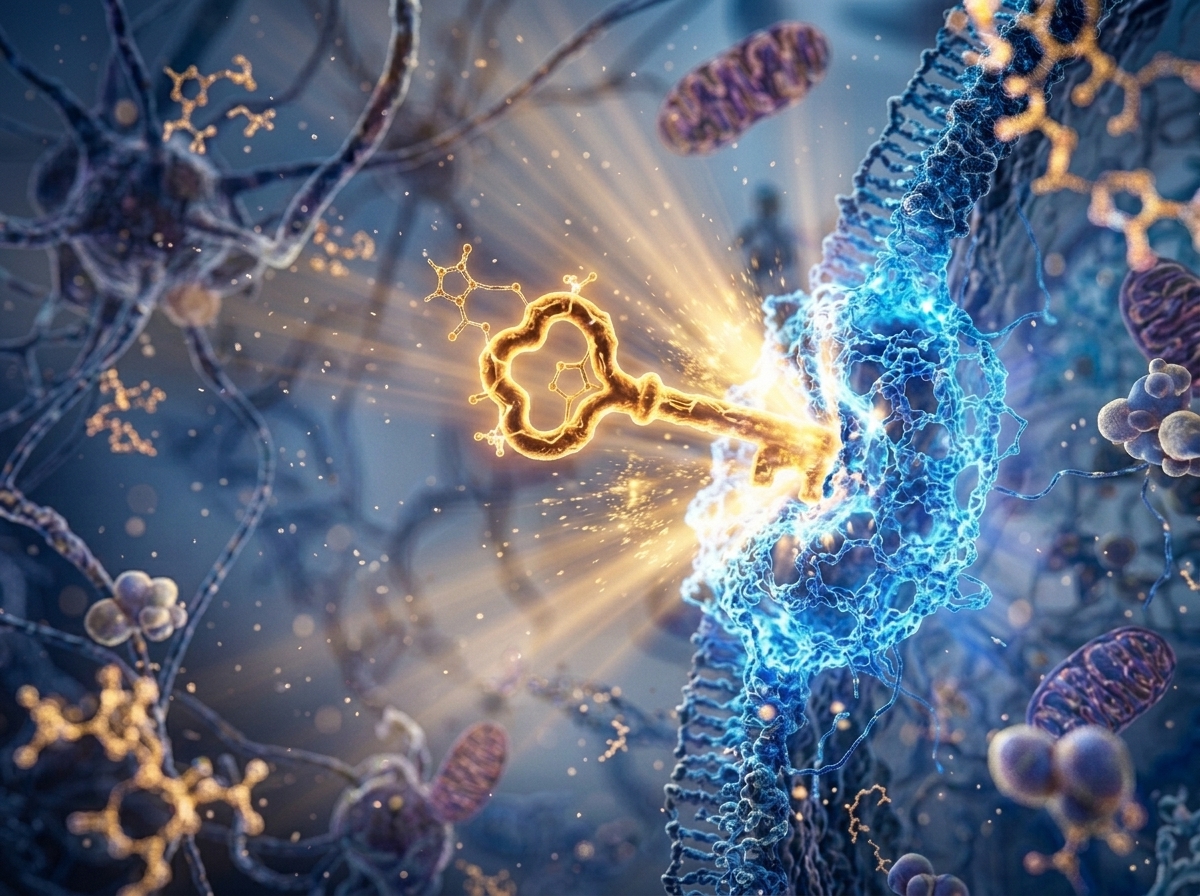
That sensitivity is the heart of how peptides work. These molecules are not powerful because they are large or abundant — most are neither. They are powerful because they are specific: each one is shaped to be recognised by a particular partner, and almost nothing else.
Understanding that recognition — what it is, why shape governs it, and how easily it breaks — is the key to understanding peptide biology. We will build it up one layer at a time; if the basics are still new, our explainer on what peptides are covers the ground first.
How does a peptide deliver a message?
Start with the simplest picture. A signalling peptide is a messenger. It is released by one cell, travels a short distance, and is detected by another cell that has the right equipment to receive it.
That equipment is a receptor — a protein, usually embedded in the surface membrane of the receiving cell, whose job is to recognise one specific signal. When the peptide reaches a matching receptor, it binds. That binding event is the message being delivered.
Crucially, the peptide itself rarely enters the cell or does the work directly. It acts more like a knock on a door. The receptor, having registered the knock, sets off a chain of events inside the cell — and that internal chain is what produces the actual effect (Hilger et al., 2018).
Think of it as a postcode. The peptide does not carry the parcel; it carries the address. Only the cell with the matching receptor is “at that address”, which is how a signal released into the bloodstream can reach some cells and be completely ignored by others.
Why does shape matter so much?
Here is where the postcode analogy needs upgrading. A receptor does not read a written address — it recognises a shape.
A peptide, despite being a flexible chain, tends to adopt a particular three-dimensional form, or a small set of forms. The receptor has a binding site — a pocket or groove — with a complementary form. Recognition happens when the two fit together, surface against surface, like a hand into a glove.
This idea is old and durable. In 1894, the chemist Emil Fischer proposed what became known as the “lock-and-key” model to explain how enzymes recognise their targets (Fischer, 1894). The metaphor has been refined since — both partners flex slightly as they meet, so “lock and key” is now often described as more of a handshake — but the core insight holds. Function follows form.
Why is a receptor like a tuned radio?
There is a second analogy worth holding alongside the lock and key, because it captures something the first one misses: the sheer crowdedness of biology.
At any moment, the fluid around a cell carries a great many different signalling molecules at once — a constant background hum of chemistry. The cell does not respond to all of it. Each receptor is, in effect, tuned to one frequency, and it stays silent to everything else on the dial.
A peptide, in this picture, is a broadcast on a specific frequency. It is released into the noise, and only the cells carrying a receptor “tuned” to it pick it up. The message can be everywhere in the bloodstream and still reach only its intended audience.
The analogy also explains why small sequence changes matter so much. Shift a broadcast slightly off-frequency and the tuned receiver no longer locks on. Editing a peptide’s amino acids does something comparable: it moves the molecule off the frequency its receptor was built to detect.
What happens when a peptide meets its receptor?
The moment of binding is not the end of the story — it is the trigger. When a peptide settles into its receptor’s binding site, the receptor changes shape.
That shape change is the signal passing through the membrane. The part of the receptor inside the cell shifts, and that shift is “read” by other molecules waiting on the inside. Often this sets off a cascade — one molecule activating several others, each of those activating several more.
This cascade has a useful consequence: amplification. A single peptide binding a single receptor can, through the cascade, produce a large change inside the cell. A faint knock at the door can summon the whole household. It is one reason peptides can act at vanishingly low concentrations.
The cascade also explains why the same peptide can do different things in different cells. The signal that arrives is the same; what the cell does with it depends on the internal machinery that cell happens to have. Context, not just the messenger, shapes the outcome.
Why does a single amino acid change so much?
Return to the claim we opened with. If recognition depends on shape, and shape depends on the amino acid sequence, then changing the sequence can change the shape — and a changed shape may no longer fit.
Sometimes the change is at the binding interface itself. Swap one amino acid in the stretch that contacts the receptor, and you may remove a charge the receptor depended on, or introduce a bulky group that no longer fits the pocket. The peptide is still a peptide; it simply no longer matches its lock.
Other times the change is elsewhere, and acts indirectly — nudging the chain into folding differently, so the binding surface is subtly distorted even though its own amino acids are untouched.
This is why researchers treat sequence with such care. If the relationship between amino acids, peptides and proteins is still hazy, our guide to peptides vs proteins vs amino acids lays out the building blocks.
Can a peptide block a signal as well as send one?
So far we have described peptides that activate a receptor — bind it, change its shape, set off the cascade. Molecules that do this are called agonists. But binding and activating are not the same thing, and that gap is enormously useful.
A peptide can be designed, or can naturally happen, to fit a receptor’s binding site without triggering the shape change that fires the signal. It occupies the lock but does not turn the key. A molecule that behaves this way is called an antagonist — it works by blocking rather than sending (Wang et al., 2022).
This is why two peptides aimed at the same receptor can have opposite effects. One switches the pathway on; the other holds the door shut. The difference between them may again come down to a handful of amino acids — enough to preserve the fit but lose the activation.
Do all peptides work through receptors?
Not quite. Receptor signalling is the most studied route, but it is not the only one.
Some peptides act on structures rather than receptors. Antimicrobial peptides, for instance, work largely by disrupting the membranes of microbes directly — a physical effect rather than a coded message. Others bind not to a surface receptor but to targets inside the cell, or interact with ion channels to change how a cell handles electrical signals.
There is also an important class of molecules that are not peptides at all but work alongside them. NAD+, a coenzyme central to how cells produce energy, is a case in point — a different kind of molecule, on a different schedule, explored in our article on NAD+ and cellular energy.
What stops a peptide from working forever?
A signal that never switched off would be useless — biology depends on messages that fade. So peptides are built to be temporary.
Once released, a peptide is exposed to enzymes called peptidases, whose role is to cut peptide chains apart. Within minutes, often less, a circulating peptide is broken down into fragments and its message ends. The receptor, too, is frequently pulled inside the cell after binding, resetting the system.
This deliberate fragility has a practical consequence for research. A peptide studied in a test tube, free of these enzymes, may behave quite differently from the same peptide in living tissue (Di, 2015).
What researchers are asking next
Much of the current frontier is about precision. Researchers want to know, at the level of individual atoms, exactly how a given peptide sits in its receptor — and modern structural techniques are starting to deliver that detail (Hilger et al., 2018).
Another open question is selectivity. Many receptors come in families of close relatives, and a peptide intended to engage one may also brush against its cousins. Understanding and reducing that cross-talk is painstaking work.
And there is the perennial problem of fragility. A great deal of research effort goes simply into understanding why some sequences survive in the body and others vanish in seconds — a question that is far from settled.
Further reading from our research series
- What Is a Peptide?The tiny molecule your body already speaks — start here.
- From Cone Snail Venom to the Lab BenchWhere peptides really come from — nature’s chemistry kit.
- Peptides vs Proteins vs Amino AcidsLetters, words, sentences — the real differences.
- From Insulin to Now: A Century of Peptide DiscoveryHow a sleepless surgeon’s idea started modern peptide science.
- NAD+: The Molecule Behind Cellular EnergyThe coenzyme at the heart of how cells make energy — and age.
- GHK-Cu: The Copper Tripeptide in Your BloodstreamA 50-year-old molecule, examined with measured eyes.
References
- Fischer, E. (1894). Einfluss der Configuration auf die Wirkung der Enzyme. Berichte der deutschen chemischen Gesellschaft, 27(3), 2985–2993. doi.org/10.1002/cber.18940270364
- Hilger, D., Masureel, M. & Kobilka, B. K. (2018). Structure and dynamics of GPCR signaling complexes. Nature Structural & Molecular Biology, 25(1), 4–12. doi.org/10.1038/s41594-017-0011-7
- Di, L. (2015). Strategic approaches to optimizing peptide ADME properties. The AAPS Journal, 17(1), 134–143. doi.org/10.1208/s12248-014-9687-3
- Wang, L., Wang, N., Zhang, W., et al. (2022). Therapeutic peptides: current applications and future directions. Signal Transduction and Targeted Therapy, 7, 48. doi.org/10.1038/s41392-022-00904-4