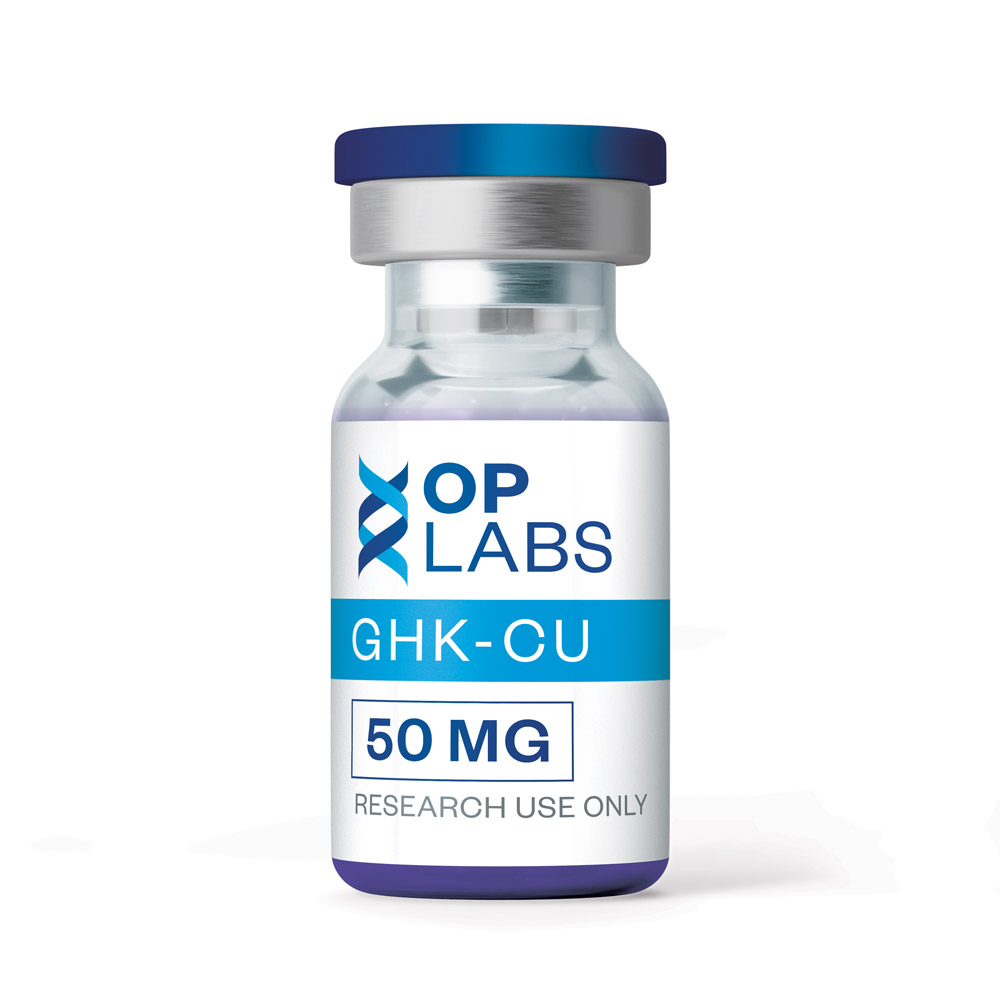
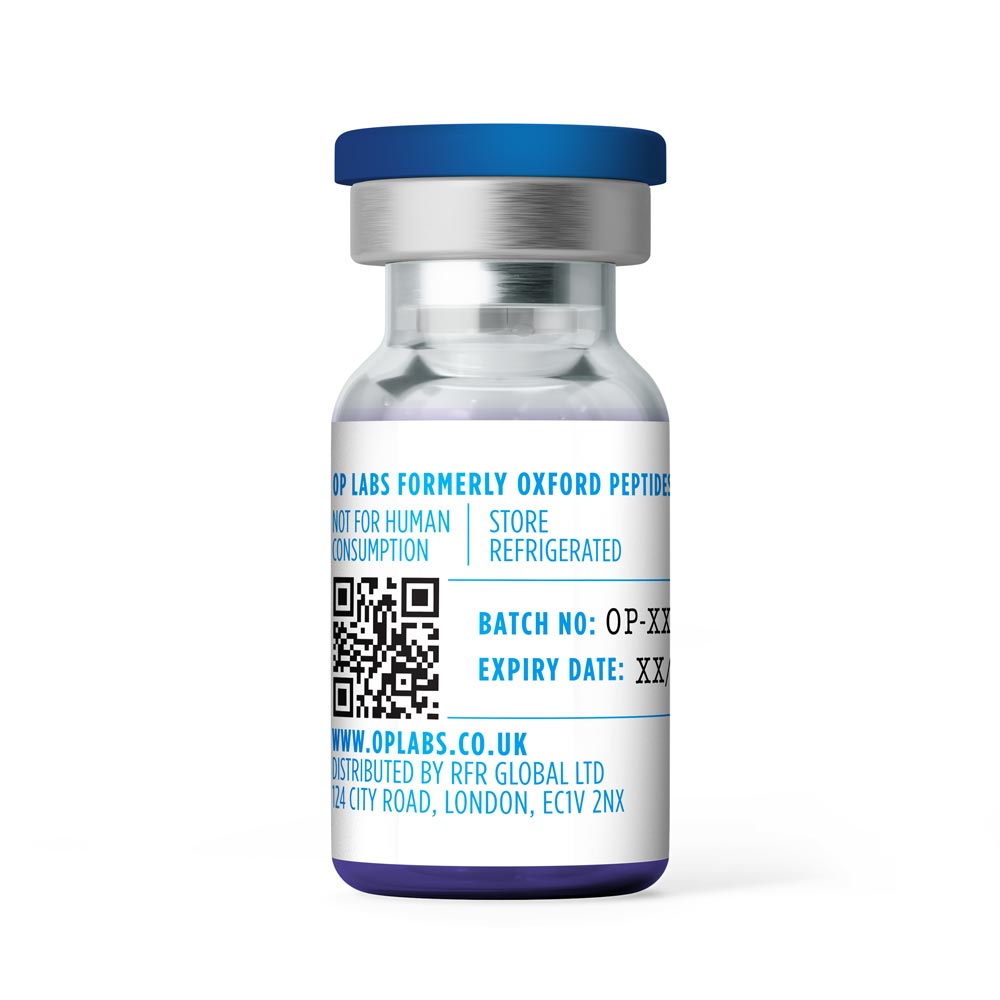

- OP Labs formerly Oxford Peptides.
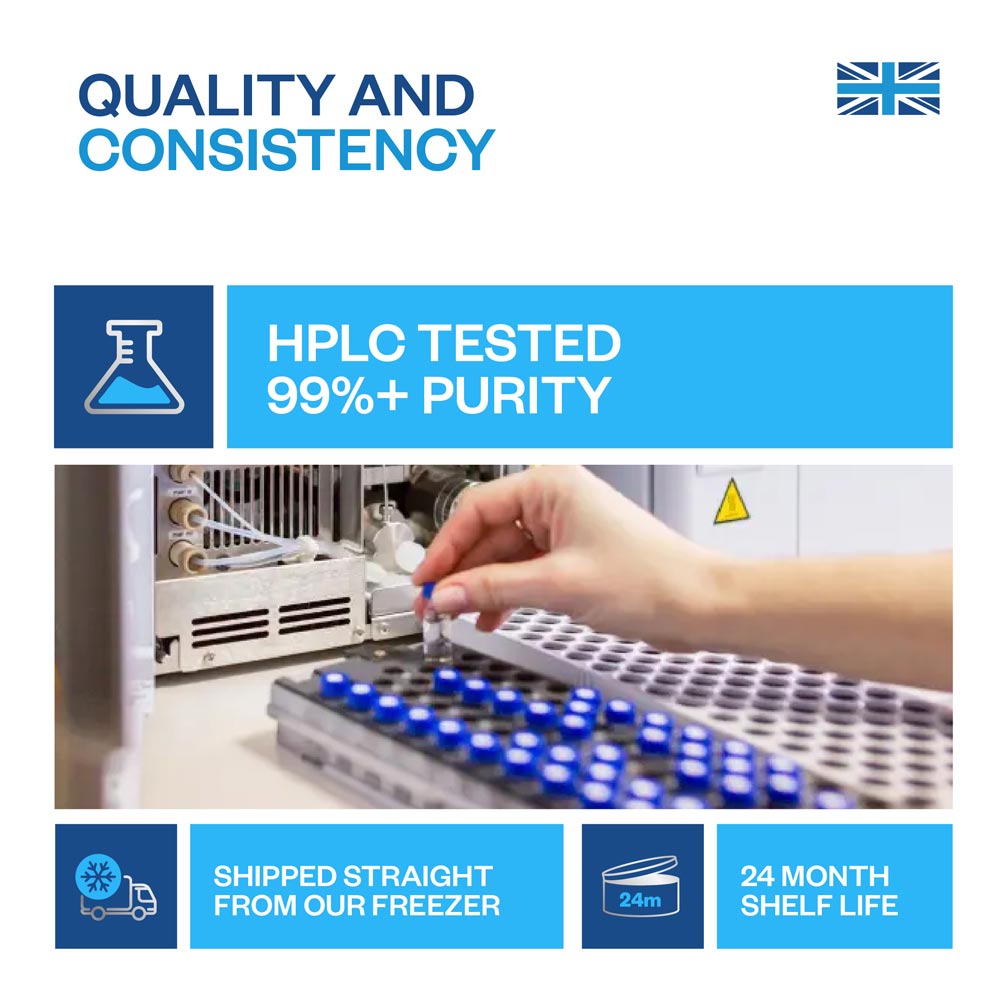
- Batch HPLC tested at 99%+ purity.
- Store frozen long term or in fridge when ready to be used.
- Sold for research purposes only.
- Contact us for Wholesale Orders.
Download COA here: GHK-CU COA.pdf
Please note if you have a different Batch ID please contact us for the latest COA.
GHK-Cu
Synonyms / Designations: GHK-Cu, Copper Tripeptide-1, Glycyl-L-histidyl-L-lysine copper complex
CAS Number: 49557-75-7
Molecular Formula: C14H24CuN6O4
Molecular Weight: 403.92 g/mol
Purity: ≥ 99 % (HPLC)
Appearance: Blue to deep blue lyophilised powder
Pack Size: 50 mg (total)
Storage: Desiccated, protected from light, stored at –20 °C or below
Solubility: Water and buffered aqueous solutions; limited solubility in organic solvents.
Description & Mechanism
GHK-Cu is a naturally occurring copper–peptide complex that functions as an endogenous signalling molecule involved in metal ion transport and cellular regulation. It consists of the tripeptide glycyl-L-histidyl-L-lysine complexed with a divalent copper ion, forming a high-affinity chelate that facilitates controlled copper delivery within biological systems. In biochemical and cellular research settings, GHK-Cu modulates cellular signalling processes through both peptide-mediated interactions and copper-dependent biochemical activity.
Copper is an essential trace element required for numerous enzymatic and structural proteins involved in redox balance, extracellular matrix organisation, and cellular metabolism. By acting as a carrier and regulator of bioavailable copper, GHK-Cu plays a role in maintaining metal homeostasis and influencing downstream pathways linked to cellular growth, differentiation, and tissue remodelling.
In preclinical research models, exposure to GHK-Cu has been associated with altered gene expression patterns and modulation of signalling pathways related to extracellular matrix dynamics, oxidative stress response, and cellular turnover. These effects are context-dependent and vary with concentration, exposure duration, and experimental system, making GHK-Cu a widely used molecular tool for investigating copper-mediated signalling and peptide–metal interactions in vitro and in vivo.
- As a molecular probe to study copper transport, binding, and homeostasis in biological systems.
- To investigate copper-dependent signalling pathways involved in cellular growth, differentiation, and tissue remodelling.
- In cell-based assays examining changes in gene expression, redox-sensitive signalling, and extracellular matrix regulation.
- In animal or ex vivo experimental models for mechanistic investigation of peptide–metal interactions, copper bioavailability, and metal-mediated tissue signalling processes.
Specifications Summary
| Parameter | Typical Value / Range |
|---|---|
| Purity (HPLC) | ≥ 99 |
| Appearance | Blue to deep blue lyophilised powder |
| Molecular Weight | 403.92 g/mol |
| Compound Type | Copper-binding tripeptide |
| Solubility | Water, dilute acids, DMSO |
| Storage | –20 °C, desiccated, dark |
| Pack Size | 3,000 mg (bulk) |
Handling, Reconstitution & Stability
- Weigh under inert/dry conditions; avoid moisture uptake.
- Avoid metal-chelating agents (e.g. EDTA) or buffers that may disrupt copper coordination.
- For stock solutions, dissolve in sterile water or appropriate buffered aqueous solution depending on assay requirements.
- Filter sterilize if needed (e.g. 0.22 µm) immediately prior to use.
- Aliquot and store stock solutions at –20 °C (or lower) to avoid repeated freeze–thaw.
- Monitor for precipitation or pH shifts before use in sensitive assays.
Precautions & Notes
- GHK-Cu activity is concentration-dependent; perform appropriate dose–response controls.
- Copper coordination may be affected by pH, ionic strength, and chelating agents.
- Light exposure and prolonged aqueous storage may reduce stability.
- Intended strictly for laboratory research use; not for human or veterinary application.
References
- Pickart, L. R., & Thaler, M. M. (1973). “Tripeptide in human plasma that prolongs survival of normal liver cells and stimulates growth in neoplastic liver.” Nature New Biology, 243(124), 85–87. https://doi.org/10.1038/newbio243085a0
- Pickart, L., Margolina, A. (2018). “GHK-Cu may prevent oxidative stress in skin by regulating copper and antioxidant gene expression.” Oxidative Medicine and Cellular Longevity, 2018, Article ID 3235918. https://doi.org/10.1155/2018/3235918
- Hong, Y., He, H., Jiang, C., et al. (2019). “Copper peptide GHK-Cu stimulates proliferation and expression of growth factors in human hair dermal papilla cells.” Molecules, 24(20), 3692. https://doi.org/10.3390/molecules24203692
- Pickart, L. (2008). “The human tri-peptide GHK and tissue remodeling.” Journal of Biomaterials Science, Polymer Edition, 19(8), 969–988. https://doi.org/10.1163/156856208784909345
Keywords: GHK-CU, GHK, GHKCU, Copper Peptide.