


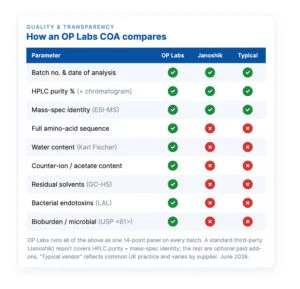
Representative specimen data. These are typical results for this product. Actual results are batch-specific and are printed on the certificate for the batch number on your vial. Research use only.
| Parameter | Result |
|---|---|
| Product name | Kisspeptin-10 |
| CAS number | 374675-21-5 |
| Molecular formula | C63H83N17O14 |
| Molecular weight | 1302.4 g/mol |
| Appearance | White to off-white powder |
| Test method | RP-HPLC (C18), UV detection at 220 nm |
| Purity (HPLC) | 99.21% (specification ≥ 98.5%) |
| Mass-spec identity | ESI-MS (positive): [M+H]+ 1303.4, confirming 1302.4 g/mol |
| Water content | 6.6% (Karl Fischer, specification ≤ 10.0%) |
| Analysis date | Representative specimen — the analysis date is printed on each batch certificate |
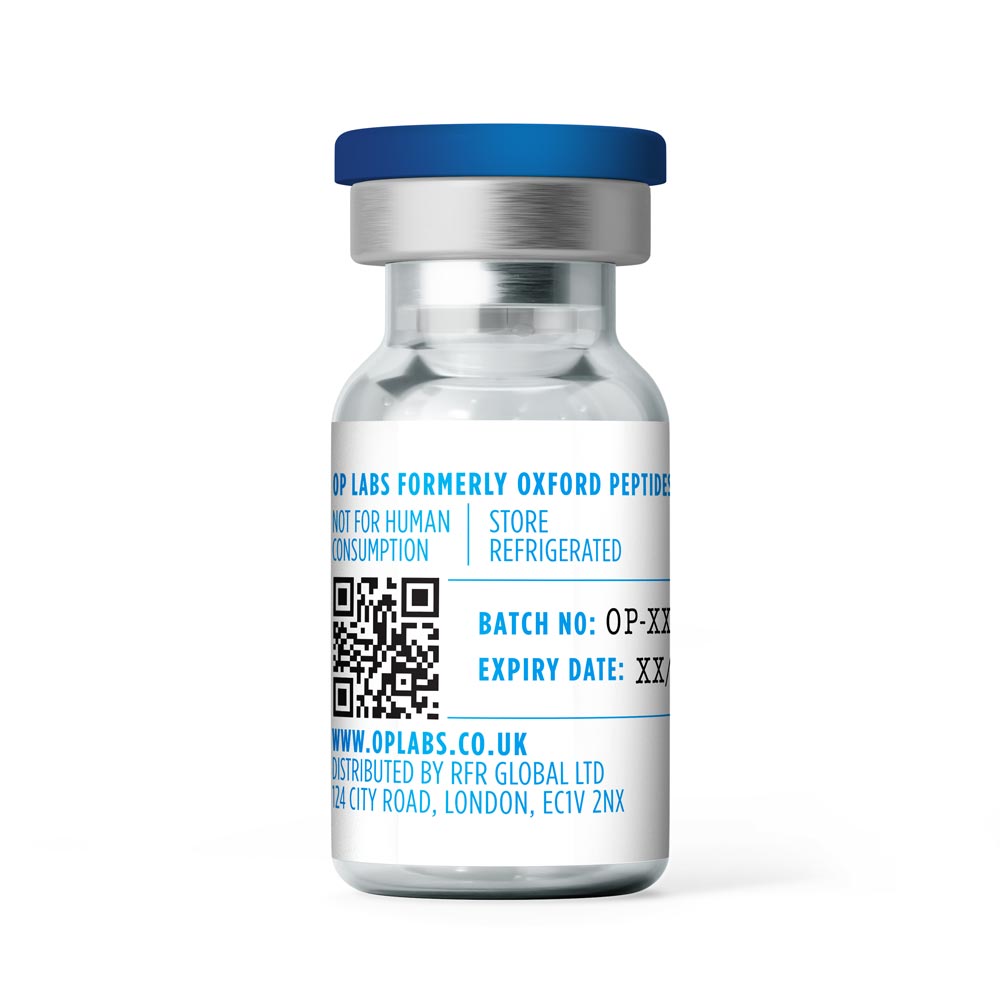
- OP Labs formerly Oxford Peptides
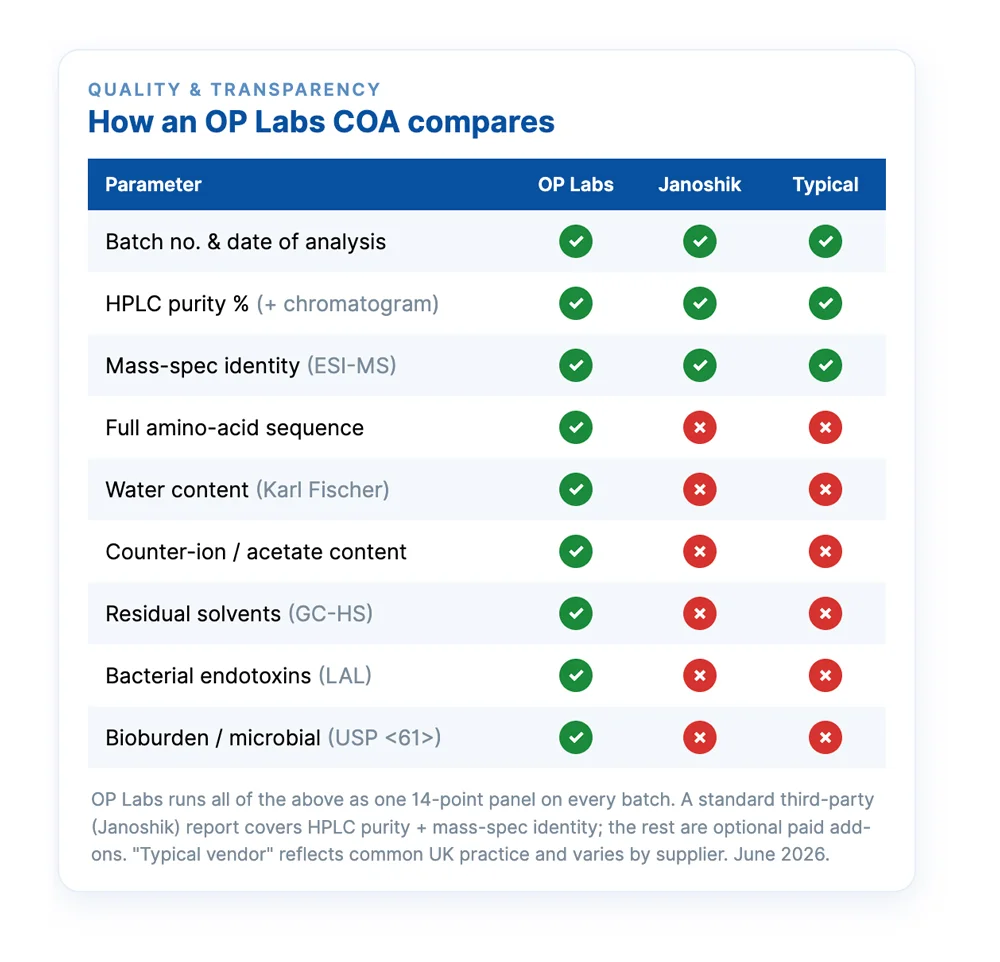
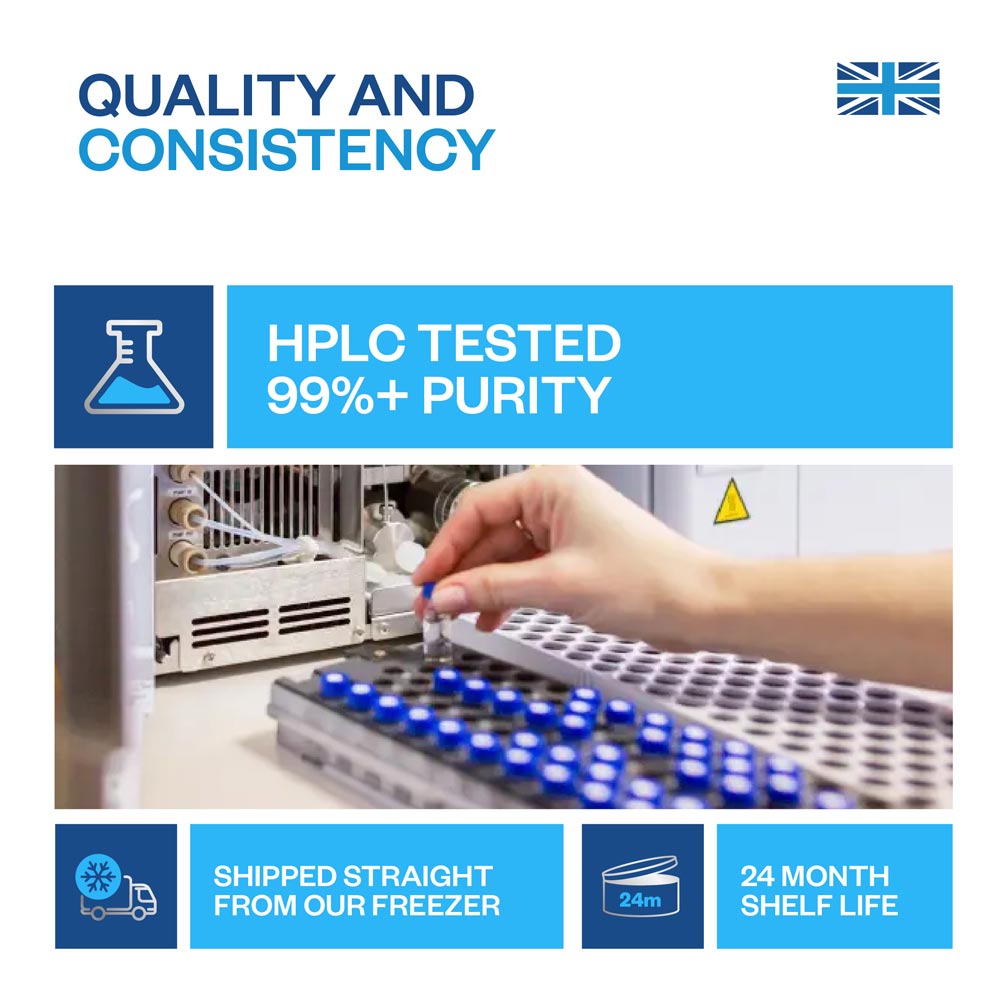
- Batch HPLC tested at 98.5%+ purity
- Store frozen long term or in fridge when ready to be used
- Sold for research purposes only
- Contact us for Wholesale Orders
Search our database for full COA analytics here.
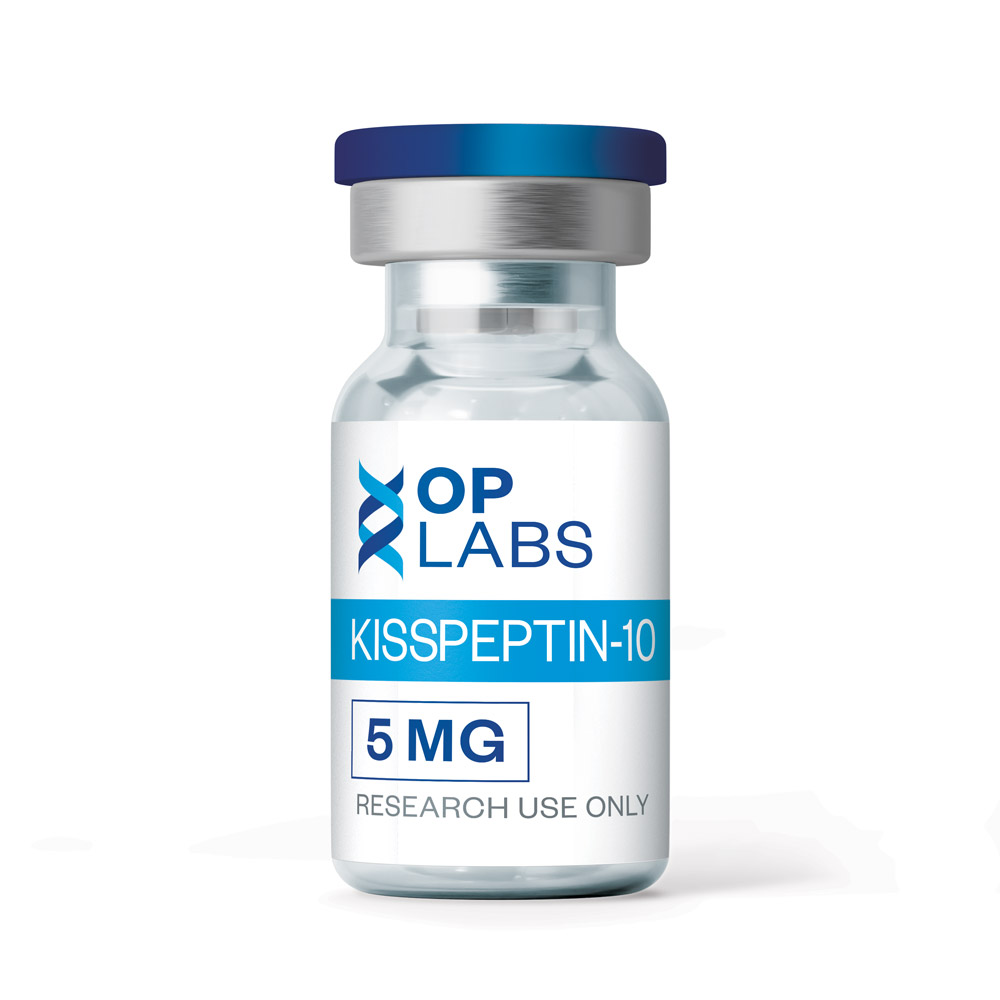
Kisspeptin-10
Synonyms / Designations: Kisspeptin-10, Metastin (10-10), KiSS-1–derived decapeptide, KISS1 receptor ligand fragment
CAS Number: 374675-21-5
Molecular Formula: C63H83N17O14
Molecular Weight: ~1302.4 g/mol
Peptide Classification: Synthetic decapeptide; KISS1-derived neuropeptide fragment
Purity: ≥ 99 % (HPLC, typical)
Appearance: White to off-white lyophilised powder
Pack Size: 5 mg (total)
Storage: Desiccated, protected from light, stored at –20 °C
Solubility: Soluble in sterile water and buffered aqueous solutions
Description & Mechanism
Kisspeptin-10 is a synthetic decapeptide corresponding to the C-terminal region of the endogenous KiSS-1 gene product. It represents the minimal bioactive fragment commonly used in research settings to study kisspeptin-mediated signalling independent of longer precursor peptides.
In biochemical and cellular research systems, Kisspeptin-10 interacts with the KISS1 receptor (also known as GPR54), a G-protein-coupled receptor expressed in hypothalamic and peripheral tissues. Experimental studies investigate receptor binding, downstream signalling cascades, and neuroendocrine pathway activation under controlled conditions. Observed molecular responses are dependent on experimental design, concentration, and model system, and are used to examine receptor-mediated signalling rather than defined physiological or clinical outcomes.
Applications in Research
- As a molecular probe for studying KISS1 receptor binding and activation
- Investigation of hypothalamic–pituitary–gonadal (HPG) axis signalling pathways
- In vitro studies examining neuropeptide-mediated receptor signalling
- Use as a reference compound in neuroendocrine and reproductive signalling research
Handling, Reconstitution & Stability
- Weigh under dry conditions; peptide is hygroscopic
- Reconstitute in sterile water or appropriate buffered aqueous solution depending on assay requirements
- Avoid vigorous agitation during dissolution
- Filter sterilize if required (e.g. 0.22 µm) immediately prior to use
- Aliquot and store reconstituted solutions at –20 °C (or lower) to minimise degradation
- Avoid repeated freeze–thaw cycles
Specifications Summary
| Parameter | Typical Value / Range |
|---|---|
| Purity (HPLC) | ≥ 99 % |
| Appearance | White to off-white lyophilised powder |
| Molecular Weight | ~1,302.4 g/mol |
| Peptide Type | Synthetic KISS1-derived decapeptide |
| Solubility | Water, buffered aqueous solutions |
| Storage | –20 °C, desiccated, dark |
| Pack Size | 5 mg |
Precautions & Notes
- Experimental behaviour of Kisspeptin-10 is influenced by receptor expression, concentration, and exposure duration
- Neuropeptide signalling responses may vary significantly across model systems
- Buffer composition, pH, and ionic strength may affect peptide stability and assay performance
- Appropriate controls are recommended to distinguish receptor-specific from non-specific effects
- Intended strictly for laboratory research use; not for human or veterinary application
References
Kotani M. et al. The metastasis suppressor gene KiSS-1 encodes kisspeptins, the natural ligands of the orphan G protein-coupled receptor GPR54. Journal of Biological Chemistry, 2001.
https://pubmed.ncbi.nlm.nih.gov/11451936/
Seminara S.B. et al. The GPR54 gene as a regulator of puberty. New England Journal of Medicine, 2003.
https://pubmed.ncbi.nlm.nih.gov/12571259/
Dhillo W.S. et al. Kisspeptin-54 stimulates the hypothalamic-pituitary-gonadal axis in human males. Journal of Clinical Endocrinology & Metabolism, 2005.
https://pubmed.ncbi.nlm.nih.gov/15998775/
Pinilla L. et al. Kisspeptins and reproduction: physiological roles and regulatory mechanisms. Physiological Reviews, 2012.
https://pubmed.ncbi.nlm.nih.gov/22396373/
Keywords: Kisspeptin-10, Metastin, KISS1 Peptide, GPR54 Ligand, Synthetic Neuropeptide
Ceri Jones (Verified Purchase) –
Excellent dero
A Mack (Verified Purchase) –
Joanne (Verified Purchase) –
Easy to order and delivered next day. Will definitely be ordering again.
Pete Robinson (Verified Purchase) –
Brad (Verified Purchase) –
Frazer D. –
As expected. Delivery next day. Frequent buyer.
Michelle O. (Verified Purchase) –
Great service and great supplier
Anonymous (Verified Purchase) –
the benefits are second to none
Sebastian (Verified Purchase) –
Alan T. (Verified Purchase) –
Excellent product 5 star rating
Paulo S. (Verified Purchase) –
Bruce D. –
Kenneth Dilliway –
Products are alwaysed packaged safely and delivered so fast. Always quality products.
Ben G. –
Yet to try this but. Quick delivery and great service.
Allan M. –
Stephen B. –
Malek –
Connor T. –
Matthew Dockrill –
Product was defective and no responses to emails. Will not be using the company again
James –
kamaljit singh –
Anonymous –
Always next day delivery and always top quality.
Anonymous –
Highly recommend
Samer –
Very fast delivery very professional approach towards customers would recommend and will buy again.
Mr Dean J Hay –
This peptide is high quality and purity, purchase this regularly as it achieves fantastic results, very highly recommended. Every peptide I’ve purchased from this company has surpassed expectations.
Melissa A. –
Just what I was looking for.
Victoria Bridger –
Got it fast, highly satisfied.
Wendy –
Quick delivery, great value for money.
Gemma –
Got here faster than anticipated.
Scott Andrews –
Great product, would buy again.
Karen Reid –
Best quality ever.
Deanne Ridgeon –
CouldnÕt ask for better quality.
Steven D. –
Great product and superfast delivery.
Fares Alseayed –
Paul –
Great service as usual my go to guys for peptides
Darren Llewellyn –
Adrian –
Great product, arrived really quick, defiantly be using this company again
Dean Hay –
Always high quality and purity and by far the best company so far, always a prompt delivery and well packaged, always my go to peptide supplier. Very reasonable prices and a good selection.
Pete Robinson –
Great product and value
Stephen Brown –
Feeling the benefits already, ordering more tomorrow
Thomas –
Perfect for my needs.
ARCHIE CHAPMAN –
Quick delivery, great quality.
Trish Ponsford –
Love the ease of use.
Rachel –
This is so well made.