
By the age of fifty, research suggests human tissues may hold substantially less NAD+ than at twenty — and scientists are still working out exactly what that means.
NAD+ is not a household name, yet it sits at the centre of how every cell in the human body produces energy. It is one of the most studied molecules in the science of ageing, and also one of the most over-claimed. Headlines promise a great deal; the published evidence is more measured.
This article sets out what the research actually shows — and, just as importantly, where it stops.
What is NAD+ and what does it do?
NAD+ stands for nicotinamide adenine dinucleotide. The “+” simply notes its electrical charge. It is not a peptide and not a protein; it belongs to a class of helper molecules called coenzymes.
Think of NAD+ as a rechargeable shuttle. Its central job is to carry tiny packets of energy — electrons — from one chemical reaction to another. In doing so it flips between two forms: NAD+ when empty, NADH when loaded. That cycle runs continuously, millions of times a second, in cells throughout the body.
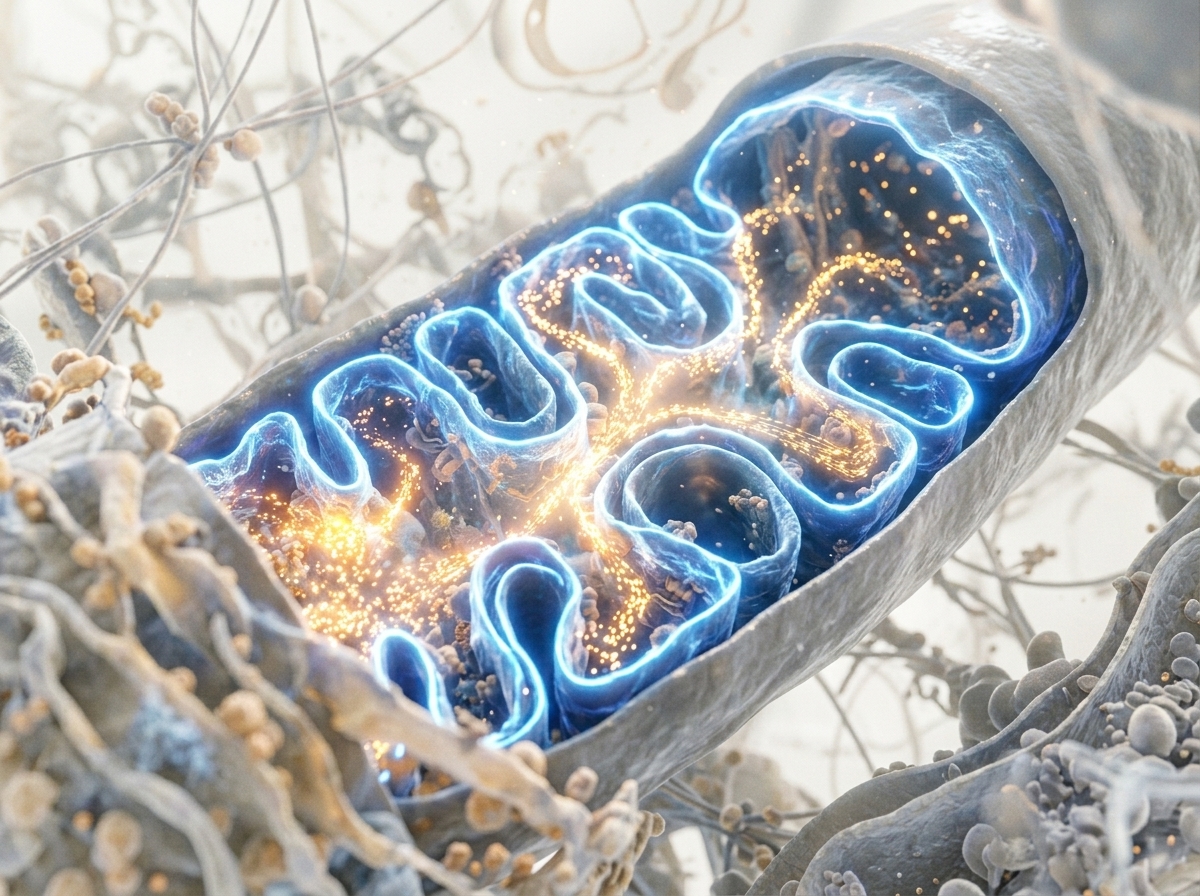
Why does that matter? Because the process of turning food into usable energy depends on it. The pathways that extract energy from glucose and fats hand their electrons to NAD+, which ferries them to the mitochondria — the cell’s power plants — where they drive the production of ATP, the cell’s actual energy currency (Verdin, 2015).
Without enough NAD+, that handover slows. The shuttle is small, but the whole supply chain of cellular energy runs through it.
Does NAD+ only handle energy?
No — and this is where it becomes genuinely interesting. NAD+ is not only an energy shuttle. It is also consumed as a raw material by other systems in the cell.
Two families of enzymes are particularly relevant. The sirtuins are enzymes involved in regulating gene activity and the cell’s stress responses, and they use NAD+ as a required substrate. A second group, the PARP enzymes, are involved in detecting and signalling DNA damage, and they too draw on NAD+ (Imai & Guarente, 2014).
This dual role is the crux of why NAD+ attracts so much research attention. It connects the cell’s moment-to-moment energy supply to longer-term processes — gene regulation, the stress response, the signalling of DNA repair. A single molecule sits at a crossroads between metabolism and maintenance.
It is worth being careful with language here. Sirtuins and PARPs use NAD+; saying so is a description of biochemistry. It is not a claim that raising NAD+ produces any particular outcome in a person — a distinction we return to below.
Where does the body get NAD+ in the first place?
Before asking why NAD+ declines, it helps to know how the body builds it — because there is not one route but several, and that matters.
The first route starts from scratch. Using the amino acid tryptophan, obtained from dietary protein, cells can construct NAD+ step by step. This is called the de novo pathway, and while it works, it is comparatively slow and accounts for a modest share of the total.
The second, and busier, route is recycling. NAD+ is constantly being consumed and broken down into fragments — chiefly a molecule called nicotinamide. Rather than discard those fragments, the cell rebuilds them straight back into NAD+. This recycling route is known as the salvage pathway, and in most tissues it does the bulk of the work.
A third entry point is the diet. The various forms of vitamin B3 — niacin, nicotinamide, and the precursors NR and NMN discussed later — feed into these pathways and top up the supply.
Two points are worth drawing out. First, NAD+ is not a static reserve; it is a fast-turning pool, continuously demolished and rebuilt. Second, because the salvage pathway carries most of the load, anything that impairs recycling — or anything that ramps up consumption — can pull the whole pool down. That sets up the question of ageing.
Why does NAD+ decline with age?
A consistent finding across many studies is that NAD+ levels fall with age in a range of tissues, in both animals and humans (Covarrubias et al., 2021). The hook figure at the top of this article reflects that broad pattern — though the exact decline varies by tissue, by study, and by how it is measured.
Why does it happen? Research points to both sides of a balance. On one side, the body’s production and recycling of NAD+ appears to become less efficient with age. On the other, consumption seems to rise.
A particular focus has been an enzyme called CD38, which consumes NAD+ and tends to become more active with age, partly in connection with low-grade inflammation (Covarrubias et al., 2021). If production slips while consumption climbs, the pool shrinks. That, in outline, is the leading explanation — though “in outline” is the operative phrase, as the full picture is still being assembled.
What happens to cells when NAD+ falls?
Here the evidence must be read with care, because much of it comes from animal and laboratory models rather than humans.
In those models, lower NAD+ is associated with reduced mitochondrial efficiency and changes in the activity of the sirtuin and PARP systems (Rajman et al., 2018). Because NAD+ touches both energy production and cellular maintenance, a decline is plausibly linked to several features of ageing biology at once — which is exactly why researchers find it compelling.
But “associated with” and “plausibly linked” are deliberate phrases. Demonstrating that an NAD+ decline causes a given feature of ageing, rather than simply accompanying it, is far harder — and in humans, that causal case is not yet established. The biology that makes NAD+ interesting also makes it difficult to study cleanly: a molecule involved in everything is hard to isolate the effect of.
To understand how this differs from the peptide signalling covered elsewhere in this series, our guide to how peptides work is a useful companion — NAD+ is a coenzyme, a different kind of molecule on a different job.
Can NAD+ be replenished? What the research suggests
You cannot usefully take NAD+ itself as a supplement — the intact molecule is not well taken up by cells. So research has concentrated instead on precursors: smaller molecules the body can convert into NAD+.
Two have received most attention. Nicotinamide mononucleotide (NMN) and nicotinamide riboside (NR) are both naturally occurring compounds that sit on the body’s own NAD+-building pathways. The research question is straightforward to state: if more precursor is supplied, does the cellular NAD+ pool rise, and does anything follow from that?
In animal studies — particularly in mice — NMN and NR have been reported to raise NAD+ levels and to be associated with various measures of metabolic function (Yoshino et al., 2018). Much of the public excitement traces back to this body of rodent work, some of it associated with researchers such as Shin-ichiro Imai and David Sinclair.
The honest framing is this: precursors such as NMN and NR are studied for their role in NAD+ metabolism, and animal research suggests they may support aspects of that metabolism in those models. That is a description of a research field — not a statement about what they will do for any individual.
What does the human evidence actually show?
This is the section that matters most, and the one most often skipped over elsewhere.
Human trials of NAD+ precursors do exist, but they are generally small, short, and limited in scope. Several have shown that NR or NMN supplementation can raise measurable NAD+ levels in human blood — that much is reasonably well supported (Yoshino et al., 2018).
What is far less settled is whether raising NAD+ produces meaningful functional benefits in healthy people. The human trials conducted so far have produced mixed and modest results, and many were not designed or sized to answer the larger questions. The gap between “this raises a biomarker” and “this changes how a person ages” remains wide and largely unbridged.
So the accurate summary is a careful one. The biology of NAD+ decline is real and well documented. The interest in precursors is reasonable and grounded in substantial animal data. But the human evidence is preliminary, the long-term picture is unknown, and claims that any NAD+-boosting compound has been “shown to reverse ageing” go well beyond what the research supports. A sceptical reading is the correct reading.
Why is NAD+ so difficult to study?
Part of the reason the evidence stays cautious is that NAD+ is genuinely hard to measure well.
NAD+ is chemically unstable once a sample is taken — it degrades quickly, so a careless measurement can read low simply because of how the sample was handled. Levels also differ markedly between tissues, so a figure from a blood sample does not necessarily reflect what is happening in muscle, brain or liver.
There is also the question of what a measurement means. NAD+ sits in different compartments within a cell — and the pool inside the mitochondria behaves differently from the pool elsewhere. A single whole-cell number can hide that detail entirely.
This is not a minor technical footnote. It is one of the reasons human studies disagree, and one of the reasons confident claims should be treated warily. When a result depends heavily on how a sample was collected and which compartment was measured, reproducibility becomes a real challenge. Good NAD+ research spends a great deal of effort simply on measuring the molecule properly — and a reader is right to ask how any reported figure was obtained.
What researchers are asking next
The open questions are substantial. One is causation: does restoring NAD+ change the trajectory of ageing in humans, or merely correct a number on a lab report?
Another is dosing and form — how much precursor, in which form, for whom, and for how long. The animal and human data do not always agree, and reconciling them is active work.
A third concerns the consumers of NAD+, especially CD38 and the inflammatory processes that drive it. Some researchers argue that slowing consumption may matter as much as boosting supply (Covarrubias et al., 2021).
NAD+ research also sits within a much older tradition of studying the body’s small, essential molecules — a tradition we trace in our history of peptide research, and one whose central lesson is patience. And if you are new to this field entirely, our explainer on what peptides are is a good place to begin building the wider picture.
In our final piece in this series, we turn to a specific, naturally occurring molecule that brings together many of these threads — the copper-binding tripeptide GHK-Cu.
Further reading from our research series
- What Is a Peptide?The tiny molecule your body already speaks — start here.
- From Cone Snail Venom to the Lab BenchWhere peptides really come from — nature’s chemistry kit.
- Lock, Key, Signal: How Peptides WorkSignalling, receptors, and why shape governs everything.
- Peptides vs Proteins vs Amino AcidsLetters, words, sentences — the real differences.
- From Insulin to Now: A Century of Peptide DiscoveryHow a sleepless surgeon’s idea started modern peptide science.
- GHK-Cu: The Copper Tripeptide in Your BloodstreamA 50-year-old molecule, examined with measured eyes.
References
- Verdin, E. (2015). NAD+ in aging, metabolism, and neurodegeneration. Science, 350(6265), 1208–1213. doi.org/10.1126/science.aac4854
- Imai, S. & Guarente, L. (2014). NAD+ and sirtuins in aging and disease. Trends in Cell Biology, 24(8), 464–471. doi.org/10.1016/j.tcb.2014.04.002
- Covarrubias, A. J., Perrone, R., Grozio, A. & Verdin, E. (2021). NAD+ metabolism and its roles in cellular processes during ageing. Nature Reviews Molecular Cell Biology, 22(2), 119–141. doi.org/10.1038/s41580-020-00313-x
- Rajman, L., Chwalek, K. & Sinclair, D. A. (2018). Therapeutic potential of NAD-boosting molecules: the in vivo evidence. Cell Metabolism, 27(3), 529–547. doi.org/10.1016/j.cmet.2018.02.011
- Yoshino, J., Baur, J. A. & Imai, S. (2018). NAD+ intermediates: the biology and therapeutic potential of NMN and NR in humans and mice. Cell Metabolism, 27(3), 513–528. doi.org/10.1016/j.cmet.2017.11.002