


Representative specimen data. These are typical results for this product. Actual results are batch-specific and are printed on the certificate for the batch number on your vial. Research use only.
| Parameter | Result |
|---|---|
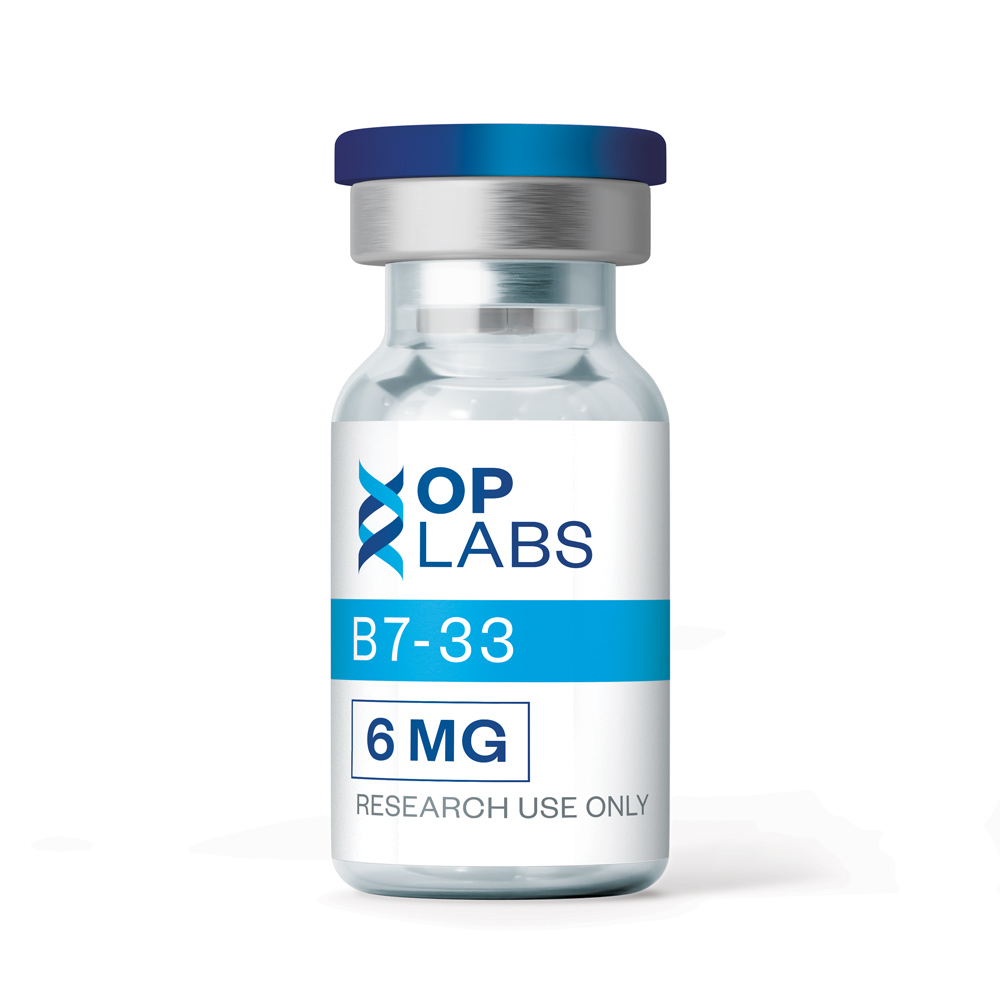
| Product name | B7-33 |
| CAS number | 1818415-56-3 |
| Molecular formula | C131H229N41O36S |
| Molecular weight | 2986.5 g/mol |
| Appearance | White to off-white powder |
| Test method | RP-HPLC (C18), UV detection at 220 nm |
| Purity (HPLC) | 98.76% (specification ≥ 98.0%) |
| Mass-spec identity | ESI-MS (positive): [M+2H]2+ 1494.3, confirming 2986.5 g/mol |
| Water content | 6.20% (Karl Fischer, specification ≤ 10.0%) |
| Analysis date | Representative specimen — the analysis date is printed on each batch certificate |
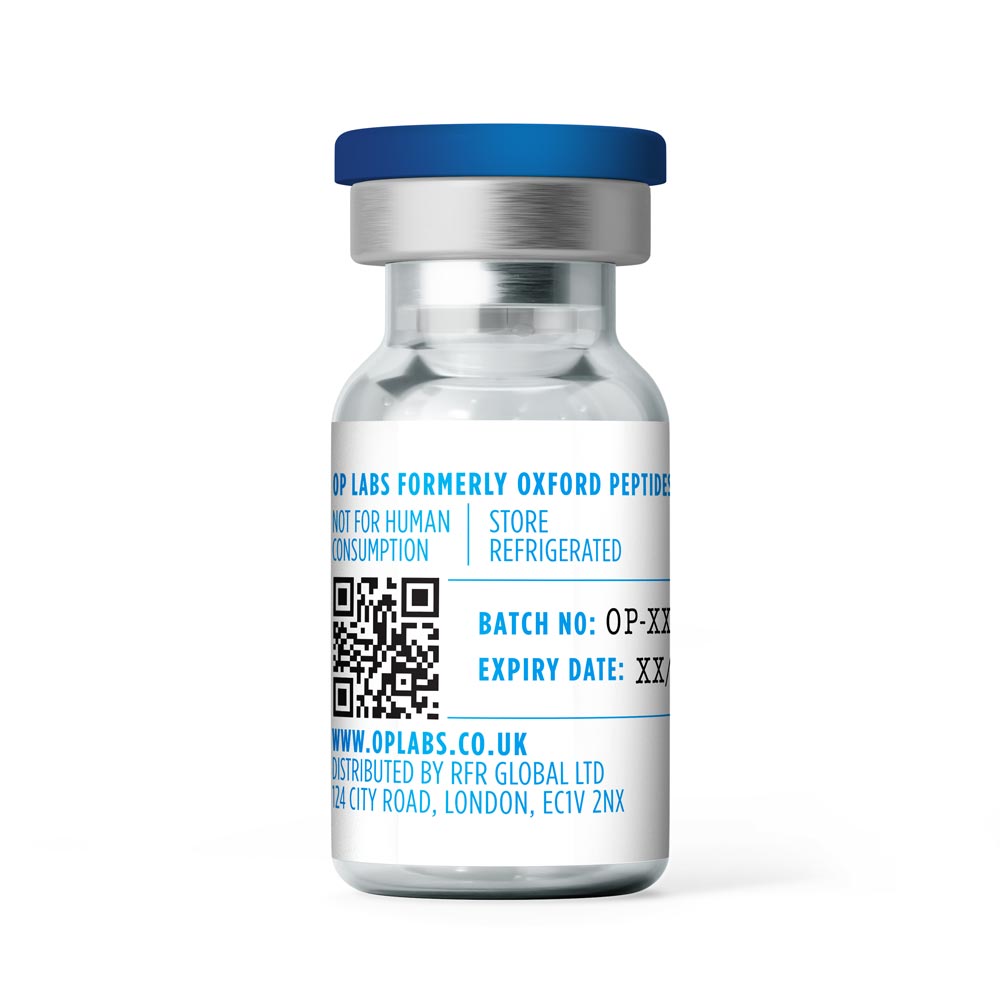
- OP Labs formerly Oxford Peptides
- Batch HPLC tested at 98.5%+ purity
- Store frozen long term or in fridge when ready to be used
- Sold for research purposes only
- Contact us for Wholesale Orders
Search our database for full COA analytics here.
B7-33
Synonyms / Designations: B7-33; single-chain relaxin-2 (H2) B-chain analogue; functionally selective RXFP1 agonist; relaxin mimetic peptide
Amino Acid Sequence: VIKLSGRELVRAQIAISGMSTWSKRSL (Val-Ile-Lys-Leu-Ser-Gly-Arg-Glu-Leu-Val-Arg-Ala-Gln-Ile-Ala-Ile-Ser-Gly-Met-Ser-Thr-Trp-Ser-Lys-Arg-Ser-Leu)
CAS Number: 1818415-56-3
Molecular Formula: C131H229N41O36S
Molecular Weight: 2986.58 g/mol
Purity: ≥ 99 % (HPLC)
Appearance: White to off-white lyophilised powder
Pack Size: 6 mg (total)
Storage: Desiccated, protected from light, stored at –20 °C or below
Solubility: Soluble in water and buffered aqueous solutions
Description & Mechanism
B7-33 is a 26-residue single-chain peptide derived from the B-chain of human relaxin-2. In research contexts it is studied as a molecular probe for signalling through the relaxin family peptide receptor 1 (RXFP1), a G protein-coupled receptor, providing a defined single-chain alternative to recombinant two-chain relaxin for receptor-pharmacology studies.
In cell-based assays B7-33 behaves as a functionally selective (“biased”) agonist, preferentially engaging the pERK1/2 signalling arm with comparatively weaker cAMP accumulation relative to native relaxin-2. In cultured fibroblast and tissue models, RXFP1 engagement has been used to interrogate TGF-β/Smad2 signalling and matrix metalloproteinase expression. Observed responses are dependent on experimental conditions, concentration and model system; the peptide is used as a molecular probe rather than for defined physiological outcomes.
Applications in Research
- In-vitro characterisation of RXFP1 receptor pharmacology and biased/functionally selective GPCR signalling (cAMP vs pERK assays)
- Cellular models of fibrosis (cardiac, renal, pulmonary, hepatic fibroblast cultures) examining collagen / TGF-β signalling
- Preclinical rodent models of adverse cardiac remodelling as a relaxin mimetic
- Structure–activity / minimal-pharmacophore studies of relaxin-derived single-chain peptides
Specifications Summary
| Parameter | Typical Value / Range |
|---|---|
| Purity (HPLC) | ≥ 99 % |
| Appearance | White to off-white lyophilised powder |
| Molecular Weight | 2986.58 g/mol |
| Peptide Type | Synthetic single-chain relaxin-family peptide (RXFP1 receptor agonist) |
| Solubility | Water, buffered aqueous solutions |
| Storage | –20 °C, desiccated, dark |
| Pack Size | 6 mg (total) |
Handling, Reconstitution & Stability
- Weigh under dry conditions; peptide is hygroscopic
- Reconstitute in sterile water or appropriate buffered aqueous solution depending on assay requirements
- Avoid vigorous agitation during dissolution
- Filter sterilize if required (e.g. 0.22 µm) prior to use
- Aliquot and store reconstituted solutions at –20 °C or below to minimise degradation
- Avoid repeated freeze–thaw cycles
Precautions & Notes
- Experimental behaviour is dependent on concentration, model system and exposure conditions
- As a receptor agonist, appropriate vehicle and receptor-negative controls are recommended
- Prolonged exposure to light, elevated temperature or aqueous environments may reduce stability
- Intended strictly for laboratory research use; not for human or veterinary application
References
Hossain MA, Kocan M, Yao ST, et al. A single-chain derivative of the relaxin hormone is a functionally selective agonist of the GPCR RXFP1. Chem Sci. 2016;7(6):3805-3819.
https://pmc.ncbi.nlm.nih.gov/articles/PMC6013806/
Praveen P, Kocan M, Valkovic A, Bathgate R, Hossain MA. Single chain peptide agonists of relaxin receptors. Mol Cell Endocrinol. 2019;487:34-39.
https://pubmed.ncbi.nlm.nih.gov/30641102/
Devarakonda T, Mauro AG, Guzman G, et al. B7-33 attenuates myocardial infarction-related adverse cardiac remodeling in mice. J Am Heart Assoc. 2020;9(8):e015748.
https://pmc.ncbi.nlm.nih.gov/articles/PMC7428518/
Handley TN, Praveen P, Tailhades J, et al. Further Developments towards a Minimal Potent Derivative of Human Relaxin-2. Int J Mol Sci. 2023;24(16):12670.
https://pmc.ncbi.nlm.nih.gov/articles/PMC10454739/
PubChem Compound Summary, CID 162662592 (B7-33).
https://pubchem.ncbi.nlm.nih.gov/compound/162662592
Keywords: B7-33, single-chain relaxin, RXFP1 agonist, relaxin mimetic peptide