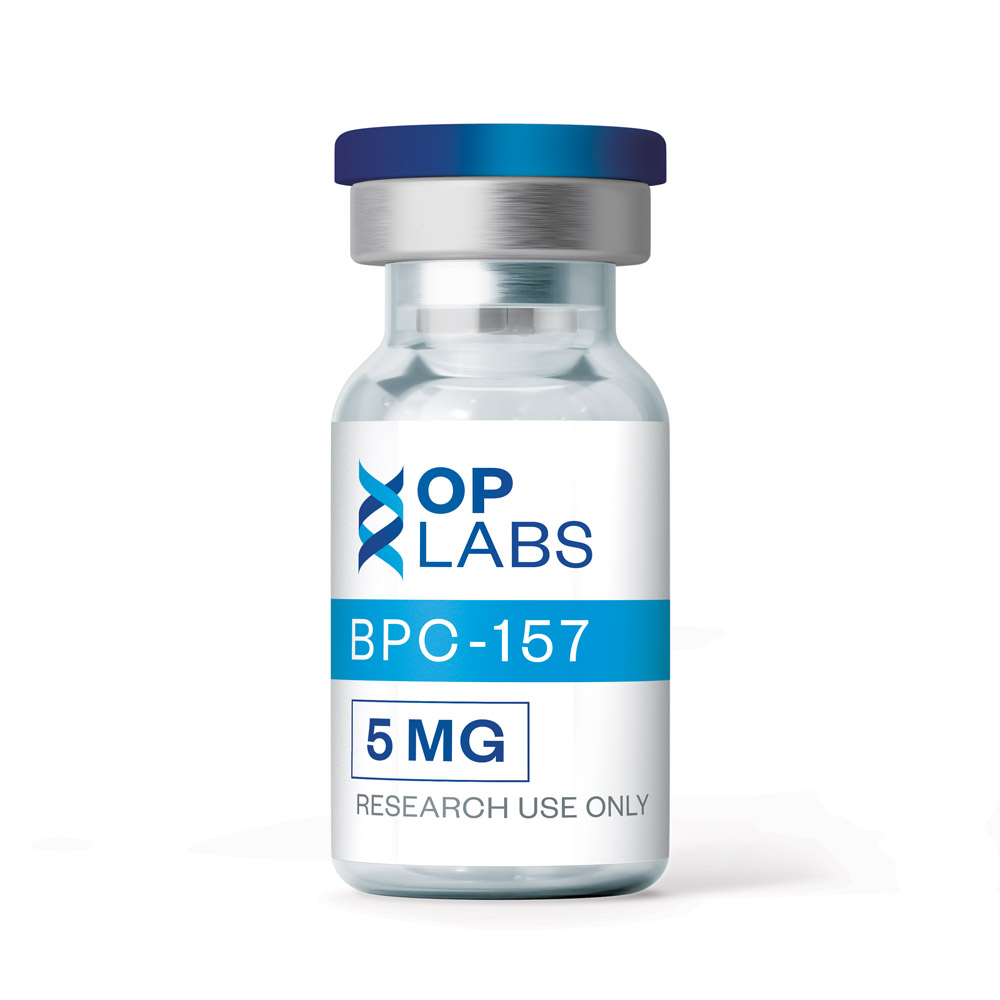
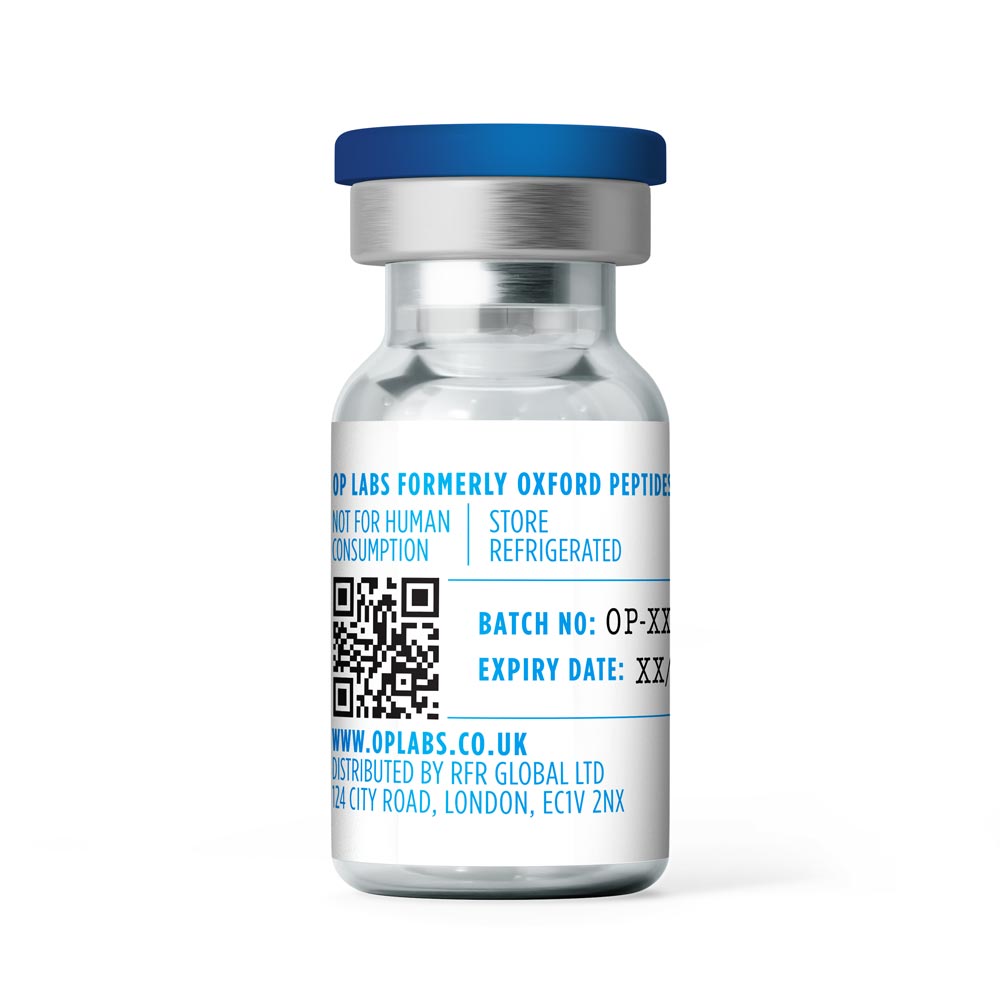


- OP Labs formerly Oxford Peptides
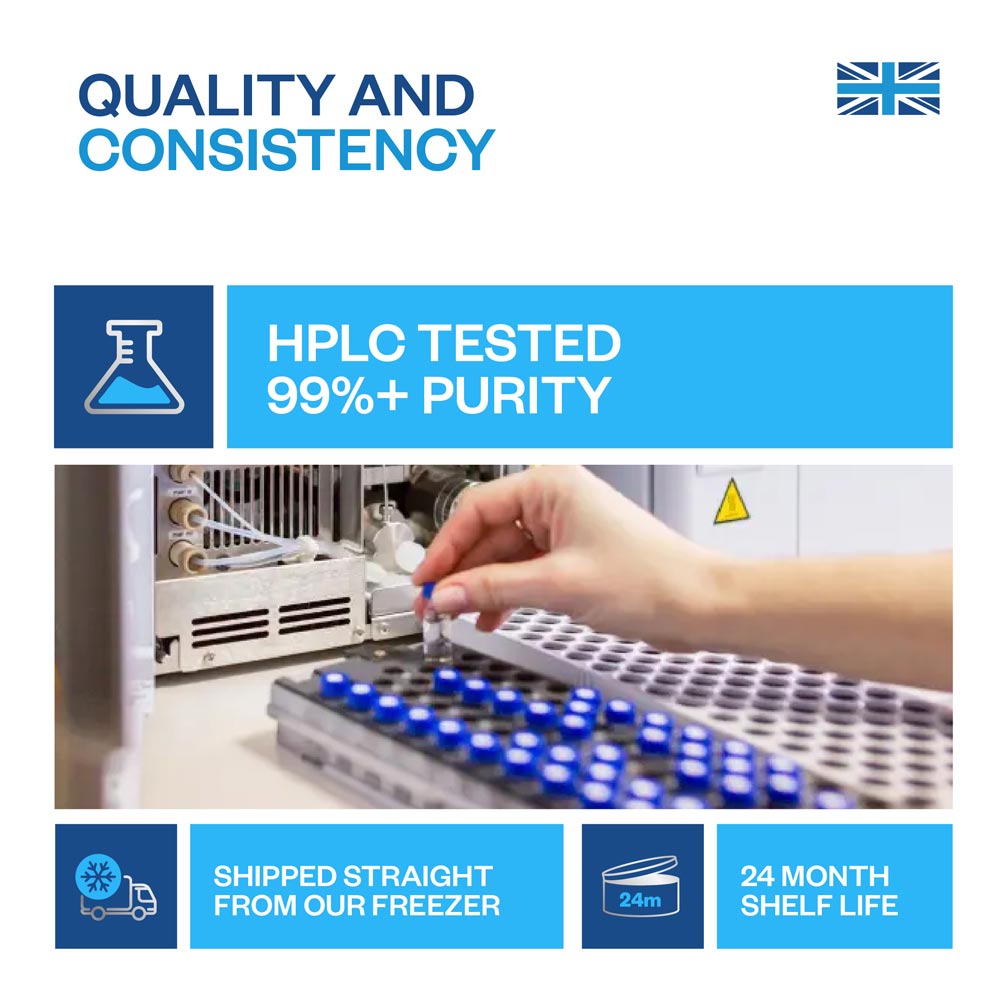
- Batch HPLC tested at 99%+ purity
- Store frozen long term or in fridge when ready to be used
- Sold for research purposes only
- Contact us for Wholesale Orders
Download COA here: BPC-157_5mg.pdf
Please note: if you have a different Batch ID, please contact us for the latest COA.
BPC-157
Synonyms / Designations: BPC-157, Body Protection Compound-157, PL-14736 (research designation)
CAS Number: 1628202-19-6
Molecular Formula: C64H102N16O24
Molecular Weight: 1479.6 g/mol
Purity: ≥ 99 % (HPLC)
Appearance: White to off-white lyophilised powder
Pack Size: 5 mg (total)
Storage: Desiccated, protected from light, stored at –20 °C or below
Solubility: Soluble in water and buffered aqueous solutions
Description & Mechanism
BPC-157 is a synthetic oligopeptide consisting of fifteen amino acids, corresponding to a defined sequence originally identified within a larger gastric-derived protein. In research contexts, it is studied as a discrete pentadecapeptide with reproducible physicochemical properties, allowing its use in biochemical, cellular, and preclinical experimental systems.
In biochemical and cellular research models, BPC-157 has been reported to interact with multiple signalling pathways, including nitric oxide–associated mechanisms, growth factor-related signalling, and cytoskeletal regulatory processes. Observed molecular and cellular responses are highly dependent on experimental conditions, concentration, exposure duration, and model system. As such, BPC-157 is utilised as a molecular probe for investigating peptide-mediated signalling behaviour rather than defined biological or physiological outcomes.
Applications in Research
- As a molecular tool to study short peptide–mediated signalling pathways
- Investigation of intracellular signalling networks involving nitric oxide–associated and growth factor-related pathways
- In vitro studies examining cytoskeletal organisation and cell–matrix interaction dynamics
- Preclinical or ex vivo experimental models for mechanistic investigation of oligopeptide signalling
Specifications Summary
| Parameter | Typical Value / Range |
|---|---|
| Purity (HPLC) | ≥ 99 |
| Appearance | White to off-white lyophilised powder |
| Molecular Weight | 1479.6 g/mol |
| Peptide Type | Synthetic pentadecapeptide |
| Solubility | Water, buffered aqueous solutions |
| Storage | –20 °C, desiccated, dark |
| Pack Size | 3,000 mg (bulk) |
Handling, Reconstitution & Stability
- Weigh under dry conditions; peptide is hygroscopic
- Reconstitute in sterile water or appropriate buffered aqueous solution depending on assay requirements
- Avoid vigorous agitation during dissolution
- Filter sterilize if required (e.g. 0.22 µm) prior to use
- Aliquot and store reconstituted solutions at –20 °C or below to minimise degradation
- Avoid repeated freeze–thaw cycles
Precautions & Notes
- Experimental behaviour of BPC-157 is dependent on concentration, model system, and exposure conditions
- Due to reported interaction with multiple signalling pathways, appropriate experimental controls are recommended
- Prolonged exposure to light, elevated temperature, or aqueous environments may reduce stability
- As of 2022, BPC-157 (PL-14736) is listed by the World Anti-Doping Agency (WADA) under the S0 category of prohibited substances; this designation is unrelated to research use
- Intended strictly for laboratory research use; not for human or veterinary application
References
Sikiric P. et al. Stable gastric pentadecapeptide BPC 157: novel therapy in gastrointestinal tract. Current Pharmaceutical Design, 2011.
https://pubmed.ncbi.nlm.nih.gov/21861833/
Hsieh M.J. et al. Therapeutic potential of pro-angiogenic BPC 157 is associated with VEGFR2 activation and up-regulation. Journal of Molecular Medicine, 2017.
https://pubmed.ncbi.nlm.nih.gov/28364310/
Krivic A. et al. Modulatory effect of gastric pentadecapeptide BPC 157 on angiogenesis in muscle and tendon healing. Journal of Physiology and Pharmacology, 2008.
https://pubmed.ncbi.nlm.nih.gov/19258669/
Jozwiak M. et al. Multifunctionality and possible medical application of the BPC 157 peptide. Pharmaceuticals, 2025; 18(2):185.
https://www.mdpi.com/1424-8247/18/2/185
Chang C.H. et al. BPC 157 enhances the growth hormone receptor expression in tendon fibroblasts. Molecules, 2014.
https://pubmed.ncbi.nlm.nih.gov/25490423/
BPC-157 in orthopaedic medicine.
https://pmc.ncbi.nlm.nih.gov/articles/PMC12313605/
Keywords: BPC-157, PL-14736, Synthetic Pentadecapeptide