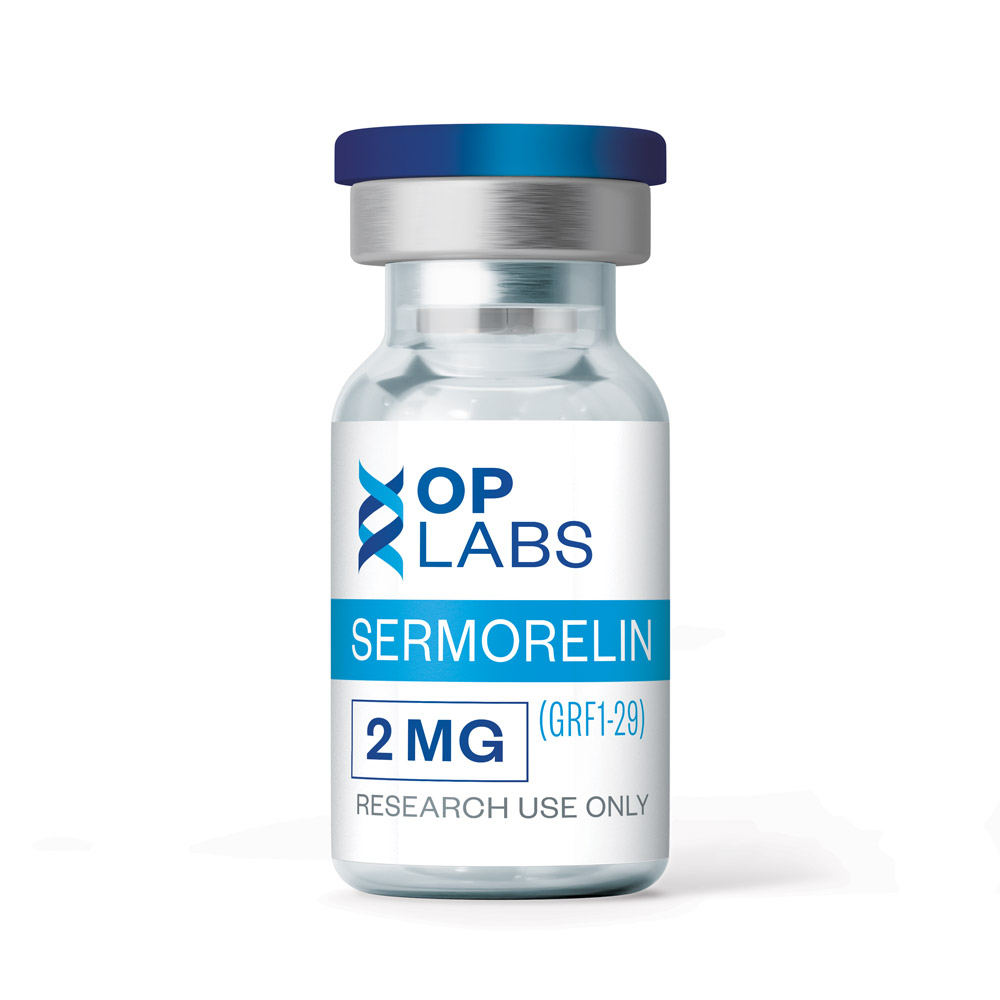


- OP Labs formerly Oxford Peptides
- HPLC tested at ≥ 99% purity
- Storage: –20 °C long term; 2–8 °C short term
- Sold for research purposes only
Sermorelin
Synonyms / Designations: Sermorelin, Sermorelin Acetate, Growth Hormone–Releasing Hormone (GHRH 1–29) analogue
CAS Number: 86168-78-7
Molecular Formula: C149H246N44O42S
Molecular Weight:3357.96 g/mol
Peptide Classification: Synthetic peptide; truncated analogue of human growth hormone–releasing hormone (GHRH)
Purity: ≥ 99% (HPLC, typical)
Appearance: White to off-white lyophilised powder
Pack Size: 2 mg
Storage: Desiccated, protected from light, stored at –20 °C
Solubility: Soluble in sterile water and buffered aqueous solutions
Description & Mechanism
Sermorelin is a synthetic peptide corresponding to the first 29 amino acids of endogenous human growth hormone–releasing hormone (GHRH). It represents the minimal biologically active fragment of GHRH and is used in research settings to investigate hypothalamic–pituitary signalling pathways involved in growth hormone regulation.
In biochemical and cellular research systems, Sermorelin interacts with the growth hormone–releasing hormone receptor (GHRH-R) expressed on pituitary somatotroph cells, initiating intracellular signalling cascades that regulate growth hormone synthesis and release. Experimental studies typically focus on receptor binding, signal transduction mechanisms, and comparative analysis relative to full-length GHRH. Observed effects are dependent on experimental design, concentration, and model system.
Applications in Research
• Investigation of GHRH receptor binding and signalling pathways
• Study of hypothalamic–pituitary axis regulation
• In vitro comparison of truncated versus full-length GHRH peptides
• Use as a reference compound in neuroendocrine and peptide signalling research
Specifications Summary
Purity: ≥ 99%
Appearance: White to off-white lyophilised powder
Peptide Type: Synthetic GHRH analogue
Molecular Weight: 3357.96 g/mol
Solubility: Water, buffered aqueous solutions
Storage: –20 °C, desiccated, protected from light
Pack Size: 2 mg
Precautions & Notes
• Experimental behaviour of Sermorelin is influenced by receptor expression, concentration, and exposure duration
• Peptide stability may be affected by pH, enzymatic activity, and buffer composition
• Appropriate controls are recommended to distinguish receptor-specific from non-specific effects
• Intended strictly for laboratory research use; not for human or veterinary application
References
Frohman L.A. et al. Growth hormone-releasing hormone: structure, gene expression and molecular heterogeneity. Acta Paediatrica Scandinavica. Supplement, 1990.
https://pubmed.ncbi.nlm.nih.gov/2220392/
DeAlmeida V.I., Mayo K.E. The growth hormone-releasing hormone receptor. Vitamins and Hormones, 2001.
https://pubmed.ncbi.nlm.nih.gov/11358116/
Momany F.A. et al. Conformational energy studies and in vitro and in vivo activity data on growth hormone-releasing peptides. Endocrinology, 1984.
https://pubmed.ncbi.nlm.nih.gov/6425039/
Keywords: Sermorelin, GHRH 1–29, Growth Hormone–Releasing Hormone, Synthetic Peptide, Neuroendocrine Signalling