
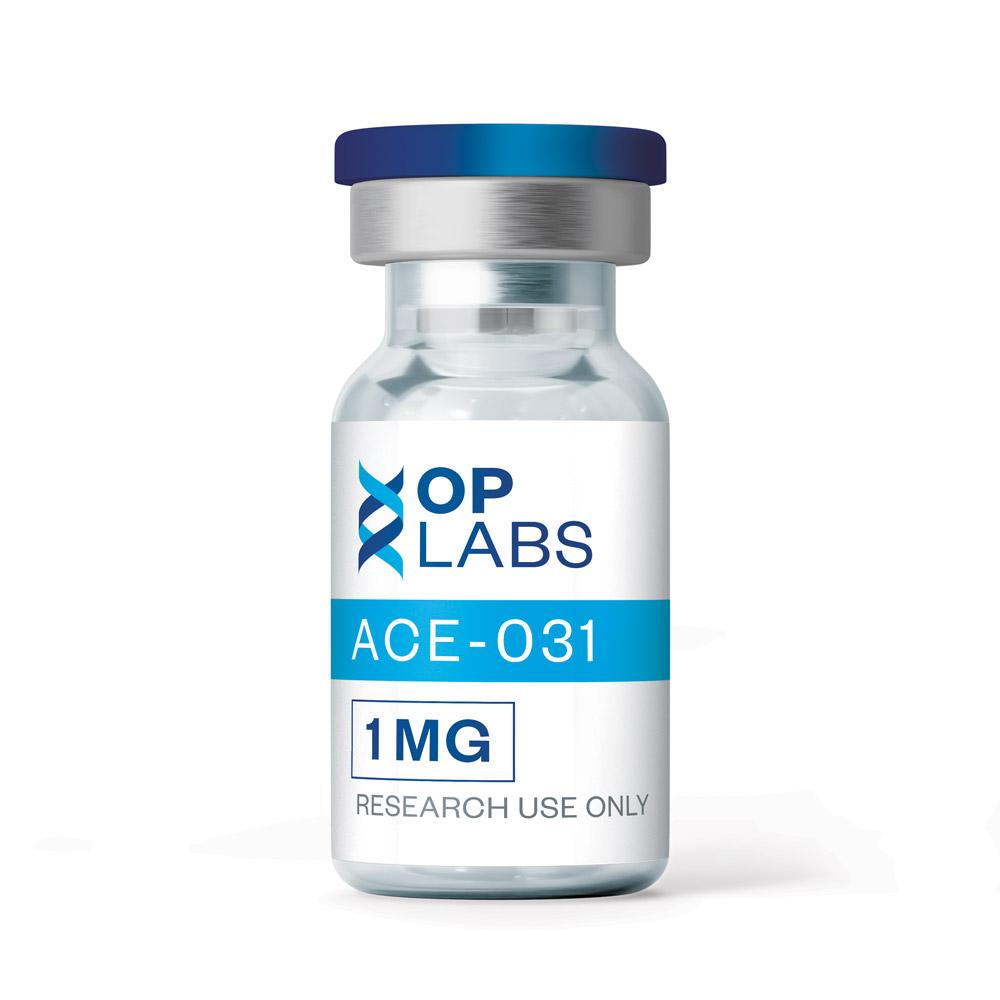
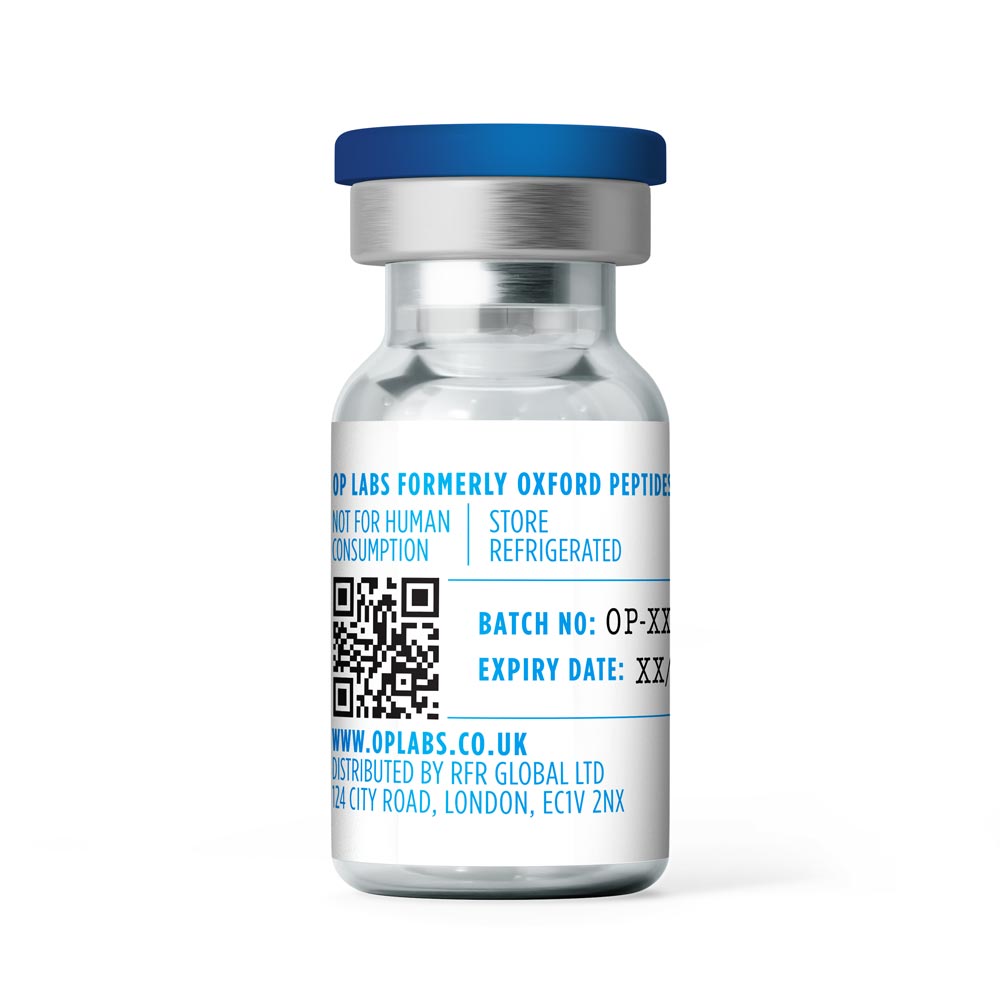



- OP Labs formerly Oxford PeptidesBatch
- HPLC tested at 99%+ purity
- Store frozen long term or in fridge when ready to be used
- Sold for research purposes only
- Contact us for Wholesale Orders
Download COA here: ACE-031_COA.pdf
Please note: if you have a different Batch ID, please contact us for the latest COA.
ACE-031
Synonyms / Designations: ACE-031, ActRIIB-Fc, Activin Type IIB receptor fusion protein, Myostatin-binding fusion protein
CAS Number: 1621169-52-5
Molecular Formula: C133H227N43O33
Molar Weight: 2956.5 g/mol
Protein Composition: Extracellular domain of human activin receptor type IIB (ActRIIB) fused to the Fc region of human IgG1
Protein Classification: Recombinant fusion protein; soluble decoy receptor
Purity: ≥ 99 % (HPLC / SEC, typical)
Appearance: White to off-white lyophilised powder
Pack Size: 1 mg (total)
Storage: Desiccated, protected from light, stored at –20 °C
Solubility: Soluble in sterile water and buffered aqueous solutions
Description & Mechanism
ACE-031 is a recombinant fusion protein consisting of the extracellular ligand-binding domain of activin receptor type IIB (ActRIIB) linked to the Fc portion of human IgG1. It was developed as a structurally defined soluble receptor construct for experimental investigation of ligand–receptor interactions within the transforming growth factor-β (TGF-β) superfamily.
In biochemical and cellular research systems, ACE-031 functions as a decoy receptor capable of binding select TGF-β family ligands, including myostatin (GDF-8) and activins, thereby preventing their interaction with endogenous cell-surface receptors. Experimental studies typically examine ligand binding affinity, downstream signalling modulation, and pathway inhibition under controlled conditions. Observed molecular responses are dependent on experimental design, ligand availability, and model system, and are used to explore signalling mechanisms rather than defined biological or physiological outcomes.
Applications in Research
• As a molecular tool for studying myostatin and activin ligand binding
• Investigation of TGF-β superfamily signalling regulation
• In vitro studies examining receptor–ligand sequestration mechanisms
• Use as a reference construct in fusion protein and decoy receptor research
Handling, Reconstitution & Stability
• Handle using appropriate protein-handling procedures
• Reconstitute in sterile water or suitable buffered aqueous solution (e.g. PBS)
• Gently swirl to dissolve; do not vortex
• Filter sterilize if required (e.g. 0.22 µm) immediately prior to use
• Aliquot and store reconstituted solutions at –20 °C (or lower)
• Avoid repeated freeze–thaw cycles
Specifications Summary
Purity: ≥ 99 %
Appearance: White to off-white lyophilised powder
Protein Type: Recombinant ActRIIB-Fc fusion protein
Molar Weight: 2956.5 g/mol
Solubility: Water, buffered aqueous solutions
Storage: –20 °C, desiccated, protected from light
Pack Size: 1 mg
Precautions & Notes
• Experimental behaviour of ACE-031 is influenced by ligand concentration, receptor expression, and model system
• Glycosylation state and buffer composition may affect stability and binding characteristics
• Fusion proteins may exhibit batch-dependent biophysical properties
• Appropriate controls are recommended to distinguish specific ligand sequestration from non-specific effects
• Intended strictly for laboratory research use; not for human or veterinary application
References
Lee S.J. et al. Regulation of muscle growth by multiple ligands signaling through activin type II receptors. Proceedings of the National Academy of Sciences, 2005.
https://pubmed.ncbi.nlm.nih.gov/16330774/
Attie K.M. et al. A single ascending-dose study of muscle regulator ACE-031 in healthy volunteers. Muscle & Nerve, 2013.
https://pubmed.ncbi.nlm.nih.gov/23169607/
Sako D. et al. Characterization of the ligand binding functionality of the extracellular domain of activin receptor type IIB. Journal of Biological Chemistry, 2010.
https://pubmed.ncbi.nlm.nih.gov/20385559/
Keywords: ACE-031, Ramatercept, ActRIIB-Fc, Myostatin Decoy Receptor, TGF-β Signalling, Recombinant Fusion Protein.
Reviews
There are no reviews yet.