


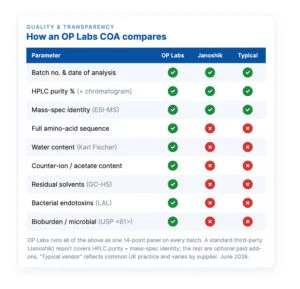
Representative specimen data. These are typical results for this product. Actual results are batch-specific and are printed on the certificate for the batch number on your vial. Research use only.
| Parameter | Result |
|---|---|
| Product name | PE-22-28 |
| CAS number | 1801959-12-5 |
| Molecular formula | C35H55N11O9 |
| Molecular weight | 773.89 g/mol |
| Appearance | White to off-white powder |
| Test method | RP-HPLC (C18), UV detection at 220 nm |
| Purity (HPLC) | 98.64% (specification ≥ 98.5%) |
| Mass-spec identity | ESI-MS (positive): [M+H]+ 774.9, confirming 773.89 g/mol |
| Water content | 6.7% (Karl Fischer, specification ≤ 10.0%) |
| Analysis date | Representative specimen — the analysis date is printed on each batch certificate |
- OP Labs formerly Oxford Peptides.
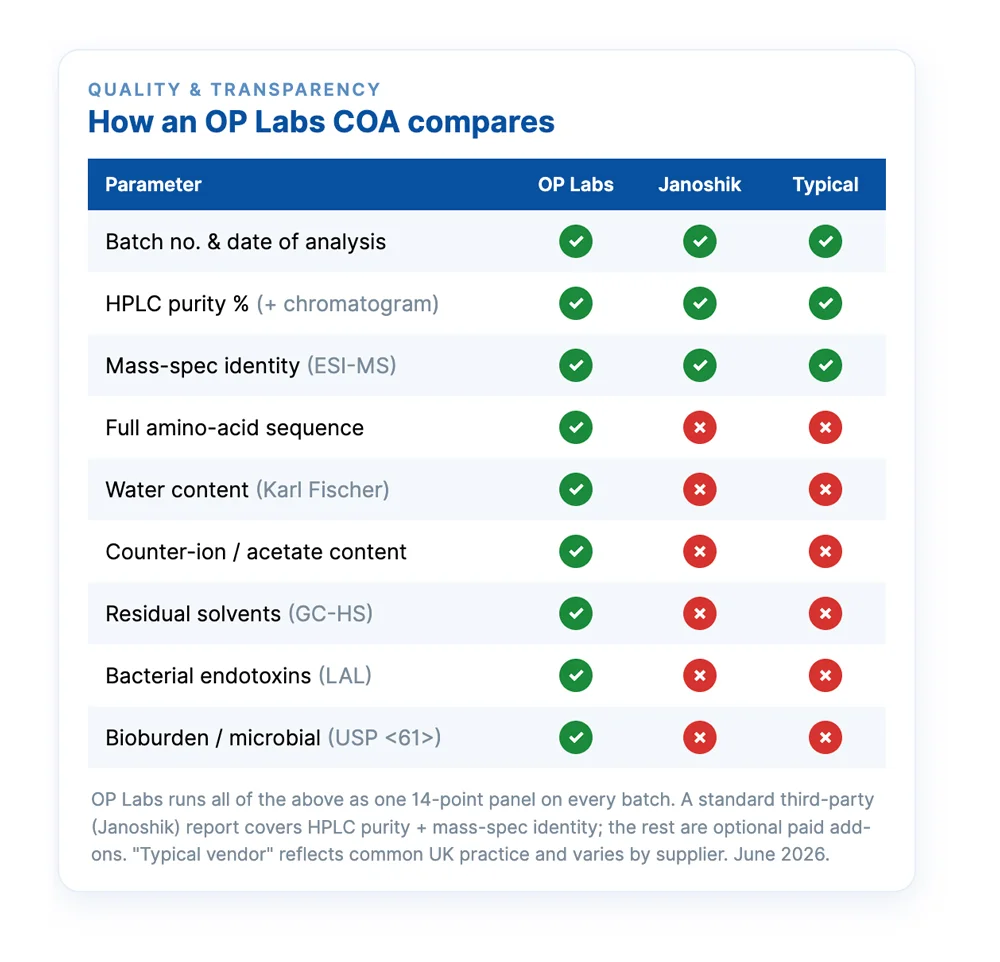
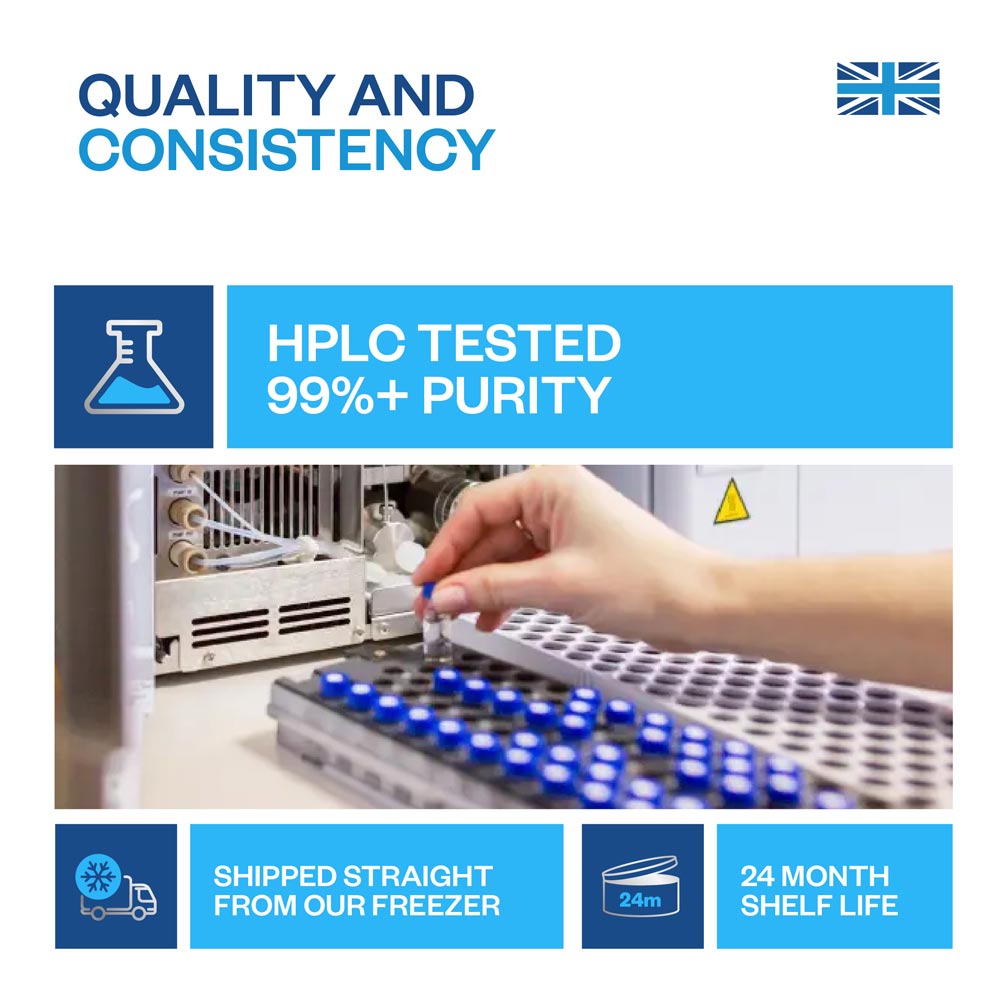
- Batch HPLC tested at 98.5%+ purity.
- Store frozen long term or in fridge when ready to be used.
- Sold for research purposes only.
- Contact us for Wholesale Orders.
Search our database for full COA analytics here.
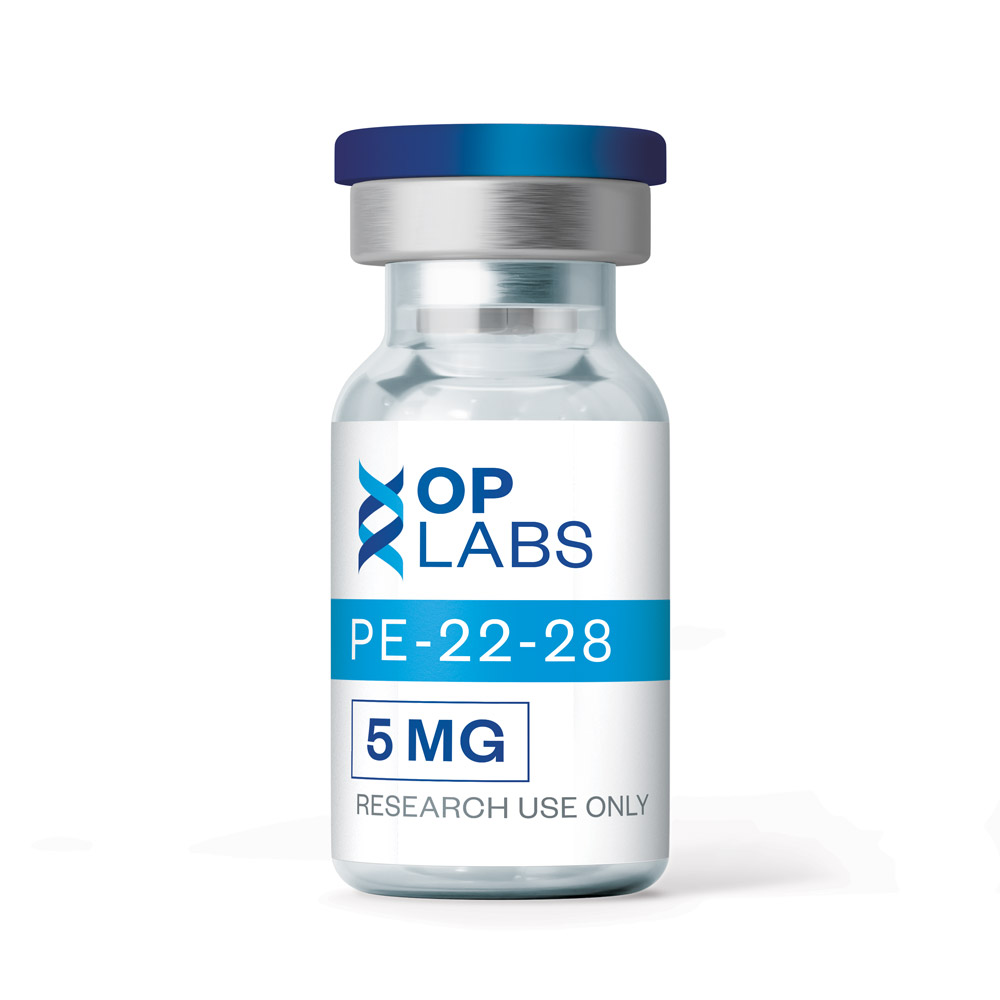
PE-22-28
Synonyms / Designations: PE-22-28, Pancreatic Polypeptide (22–28) fragment, PP(22–28), C-terminal pancreatic polypeptide fragment
CAS Number: 1801959-12-5
Molecular Formula: C35H56N12O9
Molecular Weight: ~773.89 g/mol
Peptide Sequence: Arg–Pro–Tyr–Leu–Gly–Pro–Arg
Peptide Classification: Synthetic peptide fragment derived from pancreatic polypeptide (PP)
Purity: ≥ 99 % (HPLC, typical)
Appearance: White to off-white lyophilised powder
Pack Size: 5 mg (typical)
Storage: Desiccated, protected from light, stored at –20 °C
Solubility: Soluble in water and buffered aqueous solutions
Description & Mechanism
PE-22-28 is a synthetic peptide corresponding to amino acids 22–28 of pancreatic polypeptide (PP), an endogenous peptide hormone involved in neuroendocrine signalling. The fragment represents a structurally defined region commonly used in research to study sequence-specific peptide–receptor interactions independent of the full-length parent molecule.
In biochemical and cellular research systems, PE-22-28 has been investigated for its interaction with Y-family peptide receptors and its role in modulating peptide signalling pathways associated with pancreatic and neuroendocrine communication. Experimental observations are dependent on model system, receptor expression, concentration, and exposure duration, and are used to explore signalling mechanisms rather than defined physiological outcomes.
Applications in Research
- As a molecular probe for studying pancreatic polypeptide–derived signalling
- Investigation of Y-receptor binding and peptide–receptor interaction dynamics
- In vitro studies examining structure–function relationships of PP fragments
- Use as a reference compound in neuroendocrine and peptide signalling research
Specifications Summary
Purity: ≥ 99 %
Appearance: White to off-white lyophilised powder
Peptide Type: Synthetic pancreatic polypeptide fragment
Molecular Weight: ~773.89 g/mol
Solubility: Water, buffered aqueous solutions
Storage: –20 °C, desiccated, protected from light
Pack Size: 5 mg
Precautions & Notes
- Experimental behaviour of PE-22-28 is influenced by receptor expression and assay conditions
- Peptide fragments may exhibit signalling profiles distinct from full-length pancreatic polypeptide
- Buffer composition, pH, and ionic strength may affect peptide stability
- Appropriate experimental controls are recommended
- Intended strictly for laboratory research use; not for human or veterinary application
References
Chance W.T. et al. Pancreatic polypeptide and its fragments: receptor interactions and biological activity. Peptides, 1995.
https://pubmed.ncbi.nlm.nih.gov/8594255/
Michel M.C. et al. Neuropeptide Y and pancreatic polypeptide receptors. Pharmacological Reviews, 1998.
https://pubmed.ncbi.nlm.nih.gov/9597167/
Balasubramaniam A. Pancreatic polypeptide and related peptides. Endocrine Reviews, 2003.
https://pubmed.ncbi.nlm.nih.gov/12700199/
Keywords: PE-22-28, Pancreatic Polypeptide Fragment, PP(22–28), Y-Receptor Peptide, Synthetic Peptide

Stephen S. –
Warren R. –
Extremely satisfied.
Anonymous –
Super useful.
Claire Thomas –
Well worth it.
Scott Andrews –
Love everything about it.
Rachel –
Quick delivery, product is amazing.
Lisa Jayne –
Came fast, works perfectly.
Joyce B. –
Super fast shipping, very happy.
Zaynor –
Arrived earlier than I thought.
James –
Lightning fast delivery!
Madeline E. –
Arrived quickly, exactly what I wanted.
Teresa –
Delivered fast, love the product!
Gail –
Quick delivery, perfect condition.
Julie –
Quick delivery, great quality.
Debra g. –
Excellent product and fast delivery.
Dawn –
Fast delivery, super pleased.
Megan Juniper –
Product came quicker than expected.
Anonymous –
Performs better than I thought.
Annette –
Love the ease of use.
Jonathan F. –
Love this item.
Katrina D. –
Very efficient.
Emma –
Does the job perfectly.
Evelyn Davies –
Works perfectly as expected.
Verified Buyer –
Absolutely fantastic.
Tracey D. –
Absolutely love using it.
Christine –
Exactly as described.
Ellen M. –
Outstanding quality.
Verified Buyer –
Love the results.
Verified Buyer –
The best IÕve seen.
Nicola A. –
Very efficient.
Dorothy –
Worth every penny..
Victoria Bridger –
Great bang for the buck.
Beth Henson –
One of my favorites.
Krys –
Top quality.
Ashleigh G. –
Well made.
Lindsey –
Completely satisfied.
Colin G. –
A real gem.
Ewan S. –
Best product ever.
Janet Smith –
CouldnÕt be better.
Alexandra –
Well worth it.
JESSICA A. –
Love everything about it.
Verified Buyer –
Beyond my expectations.
Lewis –
Great quality product.
Verified Buyer –
Very practical.
KATIE –
Totally satisfied.
Angie W. –
Just awesome.
Trish P. –
Five stars.
Kate M. –
ItÕs perfect.
Nicola B. –
Fantastic product.
Nia H. –
Does the job perfectly.
Amanda S. –
Excellent buy.
Clare –
Very impressed with the results.
Heidi –
Very durable.
Rebekah –
Fantastic product quality.
Ellen –
Fast delivery.
Rebecca –
Perfect for what I needed.
Anonymous –
Love how it works.
David –
Wish I hadnÕt bought this.
Verified Buyer –
Slow delivery, not happy.
Nick Owen –
DidnÕt work the way it should have.
Jude Bregazzi –
CouldnÕt ask for more.
Karen Bishop –
Quality is amazing.
Amy Lines –
Great investment.
Kathryn Harber –
This is really great quality.
Laura –
Very dependable product.
Anonymous –
CouldnÕt ask for more.
Angela O. –
Very practical product.
Terri –
Great product, great price.
Angharad H. –
Great bang for the buck.
Cornelia L. –
Great purchase.
Luke –
Fast delivery, would buy again.
Anna C. –
Incredibly fast shipping, thank you!
Elisha May –
Very happy with the performance.
Julia W. –
Performs wonderfully.
Chloe Wilkinson –
ItÕs really top-notch.
Anita –
The quality is outstanding.
Verified Buyer –
This is my go-to.
Laura Clarke –
A fantastic investment.
Maria Lister –
Great product, great price.
Andrea Riding –
This is a must-have.
Shane M. –
This product is the best.
Laura –
Arrived much faster than I expected.
Denise H. –
Came fast, works perfectly.
Jade –
Absolutely love the quality.
Sarah –
Very impressed with the results.
Lisa Skett –
Amazing value for money.
Sarah B. –
Super happy with how it works.
Jan P. –
I highly recommend this.